
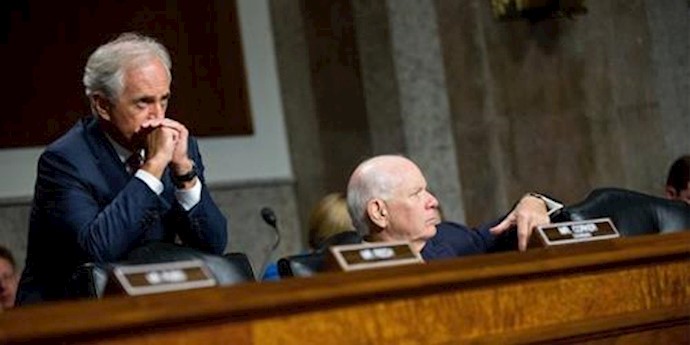
WASHINGTON – Daily Mail – From Iran to Syria to Africa, U.S. Sen. Bob Corker was often at the center of national and international issues during his first year as chairman of the Senate Foreign Relations Committee.
The Chattanooga Republican tangled with President Barack Obama’s administration over a historic deal the United States and other Western powers negotiated with Iran to keep that country from developing nuclear weapons.
Over the objections of the White House — and the threat of a presidential veto — Corker helped write and then pushed through Congress a bill that allowed lawmakers to review the deal.
In a recent interview with The Commercial Appeal, Corker discussed that work and other issues before his committee:
At one point, the president called you personally and tried to get you to hold off on the Iran bill. Tell us more about that conversation.
A: I was actually at the Chamber of Commerce meeting in Knoxville when the president called me. I was literally getting ready to be introduced at the podium. Obviously, when the president calls, you try to take it. So I stepped out and went back in the hallway of the hotel there in Knoxville.
(The president was) just railing against us pursuing this and how this was going to upset the negotiations.
I felt quite differently about it and felt that Iran, knowing that the United States Congress was going to be involved, this actually gave the administration a backstop. We could be viewed as ’the bad guys’ in this — that he had to negotiate something that would be acceptable to us.
Over time, were able to generate the support where the president knew his veto would be overridden. So at the last minute before the committee vote, he sent his chief of staff over here to let people know that they were lifting that veto threat. And, of course, it passed out of committee. It was going to pass overwhelmingly anyway. We knew that. But it ended up passing unanimously.
Staying on this subject for a minute, you told Secretary of State John Kerry during a committee hearing that U.S. negotiators on the Iran deal had been fleeced. What kind of relationship do you have with him these days?
The backdrop of the “we’ve been fleeced” statement was the night before we had an all-senators meeting (with Kerry) in a classified setting. In every case, what I found Kerry to be doing was batting away substantive questions. In every case, if you had a substantive question, he’d just bat it away and say, “Well, you don’t like the deal, then let’s just go to war.”
My temperature was probably a little bit elevated that morning (of the hearing) after having been through this long meeting of, I thought, Kerry in many ways of talking down to senators. I felt that I needed to set the tone in that meeting as one of significant pushback just to again get them back in a place where they had to answer questions in an appropriate way. And they did, for what it’s worth.
We’re fine. We have a professional relationship, let me put it that way.
Last January, when you became committee chairman, you said, “U.S. leadership is paramount. We don’t need to be the world’s policeman. But we need to be the entity that challenges wrongs.” Is the U.S. providing that leadership?
On the things the president certainly wants to show leadership on, he does so. On Iraq, people on the ground felt very much like the administration had checked the box, if you will. When the troops left, we discontinued our show of diplomacy efforts between the Shia and the Sunni, and things devolved there.
I really feel the president is so looking towards Jan. 20 of 2017 (when he leaves office). It just feels like he’s looking to the day of moving on and trying to do everything possible, just to do enough to not receive criticism but not enough to really deal with these issues.
What will your committee be working on in the coming year?
There are 27 million people enslaved around the world — 30 percent of them slaves in the sexual servitude, 70 percent of them in things like brick kilns, rug manufacturing, fishing in Ghana. It’s unbelievable what is happening around the world right now, where people with no resources and no power are being enslaved. We’re going to do something about that.
There are 600 million people a day in Africa that don’t have power. We passed something called Electrify Africa. By redirecting existing resources — not by adding resources, by redirecting existing resources — we’re going to have a huge effect on millions of people.