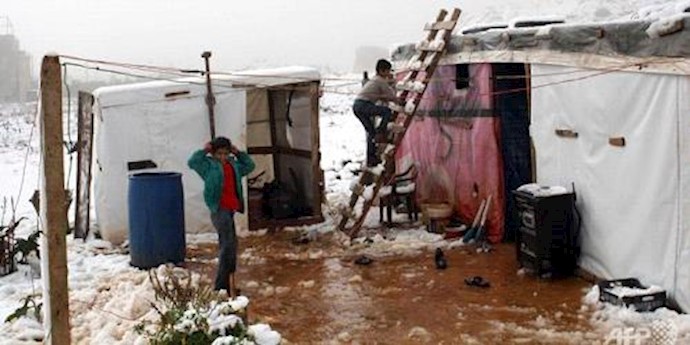
SAIDA, Lebanon: The United Nations has officially registered more than a million Syrian refugees in Lebanon, the highest concentration in the world. Refugees make up more than a quarter of the country’s population, with 70 per cent of them living below the poverty line, from as low as US$4 a day.
Around 55 per cent of refugees live in substandard living conditions, shells of empty buildings or informal settlements. At times, the only thing sheltering them from cold is a tarpaulin and a few pieces of wood.
“The roof only protects us in the summer but when winter comes it tears and collapses,” said Abou Badawi, a refugee from Homs who has been living in Lebanon for almost five years. “This year the ground is waterlogged, despite our preparations. When we wake up in the morning our tents are full of water and our mattresses are soaked.”
Almost US$2.48 billion is needed to provide basic help to refugees in Lebanon, according to the United Nations Refugee Agency (UNHCR), a huge increase from the US$13.7 million needed five years ago. The UN and other NGOs are struggling to find funds as the number of refugees continue to rise.
“We really try only to provide for them most basic needs. We are targeting the most vulnerable population and helping them survive with very little,” said Lisa Abou Khaled, Assistant Communications Officer at the UNHCR.
However, new residency laws were enacted by the Lebanese government in Jan 2015, requiring Syrian refugees to pay an annual renewal fee of US$200.
“To renew our residencies we need sponsors. We are refugees so where are we going to get the money to pay for the renewal?” said Um Amin, a Syrian refugee that came to Lebanon two years ago with four children. “My daughter here needs US$200 and my son needs US$200. How can I pay? I wish there was aid, these children need food and water.”
Um Amin has not heard from her husband since he disappeared in Syria, but for her, and the majority of those trying to scrape together an existence in the refugee camp, there are more immediate issues than paying the renewal fee.
Many end up trapped in a never ending vicious cycle of debt to landowners, or even other refugees, just so they can pay for food.
With new legislation appearing to marginalise refugees even further, it appears that for many in Syria, conditions are actually getting worse rather than better.
Source: Channel News Asia, FEB. 21, 2016