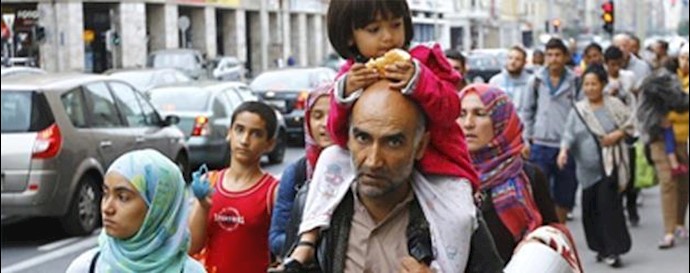
The regime of Bashar al-Assad has been coming down hard on those who have stayed behind in Syria, particularly people viewed as potential threats, while hundreds of thousands of refugees flee the country for Europe.
Ahmed al-Hamid is one of them. The 37-year-old doctor said security agents picked him up in late 2013 for his role establishing field hospitals in opposition areas in Homs and Damascus. After six months in jail—where he said he was beaten with batons and whips while strapped to boards — Dr. Hamid was released by a sympathetic judge. Last year, he fled to nearby Lebanon, joining an exodus of professionals, dissidents and others who were driven out for being on the wrong side of the Syrian regime.
“There is no order, per se, but all conditions are being put in place so that people do not dare go back,” says Dr. Hamid, a stocky man with a shaved head.
Refugees from Syria’s multisided civil war have fueled Europe’s migrant crisis. More than half the nearly 400,000 who have arrived in Europe by sea so far this year are Syrian, according to the United Nations Refugee Agency.
The West has focused largely on those fleeing ISIS and its atrocities, but Assad’s regime hasn’t relented with the intimidation and force it has used since the start of the conflict more than four years ago: detention, torture and mandatory drafting into the army for military-age men, along with starvation and an aerial bombing campaign of opposition-held areas. His government has also offered subtle incentives to leave, such as an easier time obtaining a Syrian passport and less hassle booking flights to foreign countries.
The regime’s tactics are pushing out its opponents and those perceived hostile to Assad, while friendlier groups are rebuilding from the wreckage of war. The cumulative results are broader demographic change designed to tighten Assad’s hold over the few places he still controls.
Many Syrians say the Assad regime, along with the Iran-backed Lebanese Shiite militia Hezbollah, is specifically targeting Syria’s Sunni Arab majority. Syria’s rebels are mostly Sunni, while those defending the regime are mainly members of Assad’s Shiite-linked Alawite minority and Shiite foreign fighters.
Only two pro-regime Shiite villages remain in northern Idlib province after Assad lost an air base there this week . Both Assad and his main allies in the war—Hezbollah, Iran and Russia—appear intent on maintaining control over Damascus and a corridor of territory connecting the capital with the Mediterranean coast via Homs.
U.S. officials have expressed concern that Russia is positioning itself to take a more active role defending Assad from rebel assaults.
In Damascus, the demographic changes aimed at surrounding Assad with regime-friendly groups are increasingly visible. Many residents say parts of the city’s historic quarter are now unrecognizable because of the growing presence of Iran-trained Syrian Shiite militiamen and their families.
Several predominantly Sunni areas around Damascus have been recently recaptured by the regime and its allies, prompting most residents who are seen as sympathetic to the opposition to flee.
A 27-year-old mechanical engineer and opposition activist, who asked not to be identified because his family remains in the eastern suburbs of Damascus, estimates that only 500,000 civilians are left in the area. That’s about one-third the number from two years ago, when the regime was blamed for a major chemical weapons attack on the area.
Since then the regime has kept up its bombardment of the area. In August, 556 people, including 123 children, were killed in regime airstrikes on the area, according to tallies released by local medics.
The activist arrived in Beirut last month after paying to be smuggled out through a tunnel that connects the eastern suburbs with Damascus. Many Syrians who come to Lebanon are looking to move on to Europe. And those who had settled temporarily in Tripoli are doing the same.
Since the start of the conflict in Syria, this northern Lebanese city transformed into a “second Homs” for many natives of the Syrian city. Located just about 70 miles from Tripoli, Homs is close by but remains a distant dream for many Syrians.
“It’s impossible to go back,” said Saeed Al-Sowas, a Homs native living in Tripoli. “Even those who remain inside now feel like strangers in their homeland.”
Mr. Sowas, 25 years old, who now works in a barber shop in Tripoli, says he can count at least 40 of his friends and acquaintances, mostly Homs natives, who left Tripoli for Europe since the start of this summer. He plans to join them in Europe by the end of September. He was able to obtain a Syrian passport for $1,100, a sum that he said included bribes.
The Sowas family home is in central Homs, a heavily damaged area that remains largely abandoned after the regime regained it from rebels in May 2014.
In Damascus, authorities last month began implementing a plan to build new housing units, and have started razing predominantly Sunni areas designated as illegal slums. A ceremony last month inaugurated a section of the reclaimed land for a park dedicated to the late dictator Kim Il Sung of North Korea, which has long cooperated with Syria on military and trade affairs. As many as 150,000 people living in the slums risk being displaced. Similar slums in the city occupied by Alawites weren’t affected by the regime’s housing plan.
Two weeks ago, the Homs city council approved a major reconstruction program for Baba Amr and two adjacent neighborhoods. Barazi said in an interview. He said the rebuilding plan will be covered by a new special decree to be issued by Assad shortly. The project, which calls for the creation of housing units for 65,000 people, will start in 2016 and take three to four years to complete.
Dr. Hamid came from Baba Amr, one of the first Homs neighborhoods to be recaptured by the regime in early 2012 in an incursion that killed hundreds of civilians. Among them: Dr. Hamid’s father and one of his sisters.
Today, the neighborhood is encircled by a wall and regime security forces. Mr. Barazi, the governor, said only 5% of the neighborhood’s original 41,000 inhabitants have returned, mostly because the neighborhood was destroyed by fighting. Many residents say only select Sunni families—vetted by the security forces—are allowed back, in addition to some Alawites and Shiites, who are seen as aligned with the regime.
Dr. Hamid and others say Syria’s newly simplified passport-application process is another way the regime is helping rid the country of its enemies. Before an April decree by Assad, Syrians applying for a passport needed letters from security agencies and proof of completed military service; applicants could wait months, even years, for their application to wend its way through Syria’s bureaucracy. Under the new decree, prerequisites have been waived, and people who aren’t a target of security services have been able to get passports within a month.
The decree set the passport fee at $400, but Dr. Hamid said he had to pay another $2,600 in bribes to finally obtain his because he is still wanted by some security agencies in Syria. He said he had been trying for almost a year before the decree—even with bribes—but was still unable to obtain a passport.
Now, it’s just a matter of when he will leave Lebanon, and where he will go. His mother and eldest brother are in Saudi Arabia. His youngest brother has been in Sweden for over a year. A sister who had remained in another Homs neighborhood left this week and has arrived in Greece via Turkey. He plans to follow before the end of this month, when high tides are expected to make the sea journey more dangerous. “The plan,” says Dr. Hamid, “is for us to meet in Sweden one day.”