LAUSANNE – 16 Oct. 2016-
AFP Reported:
Talks in Switzerland between Washington, Moscow and Syria’s neighbours ended within hours of starting on Saturday with no breakthrough on halting the violence ravaging the war-torn country.
US Secretary of State John Kerry said the Lausanne meeting produced some new ideas on reviving a ceasefire in Syria, where the regime continues to pound rebel-held areas in Aleppo.
But he said it was too early to reveal what these ideas were, and that high-level contacts — but not a ministerial-level meeting — would continue on Monday to flesh them out.
Kerry welcomed what he said had been more than four hours of “very candid, first time discussion … open and free-wheeling … with all of the key parties at the table simultaneously.”
“I would characterise this as exactly what we wanted,” he told reporters at the lakeside hotel where he met Russian, Iranian, Saudi, Turkish, Egyptian, Jordanian, Iraqi and Qatari envoys.
The US envoys tone was upbeat, but came despite diplomats from all sides warning against hopes of a rapid ceasefire.
And away from the talks, Moscow’s actions showed no sign that it might be softening its strong support for Syrian President Bashar al-Assad and his campaign against US-backed rebels.
Fierce fighting was also continuing elsewhere in the multi-front conflict, with Turkish-backed fighters closing in on Dabiq, a symbolic stronghold of the Islamic State group.
And in Aleppo, Assad’s Russian-backed government forces intensified their bombardment of the rebel-held east of the city, further damaging any prospect of a renewed ceasefire.
Kerry and Lavrov, once joint sponsors of international peace efforts, met ahead of the broader talks, but US officials insisted that their “bilateral track” remained dead.
Russian Foreign Minister Sergei Lavrov joined Kerry in welcoming the idea of bringing other powers into the mix saying, “we must prolong our contacts over the coming days”.
President Barack Obama has been adamant that US forces will not become caught up in the war and Kerry was hoping that talks with Russia and regional powers may yield new ideas.
Kerry said that the group — bigger than bilateral US-Russian talks, but small than the 23-nation International Syria Support Group — had proved diplomatically productive.
While there were tensions he said, they shared the goal of a reduction in violence, more humanitarian access to besieged areas and a very quick return to political dialogue.
“The way it wrapped up was to have several ideas that need to be quickly followed up,” Kerry said.
“The next contact on trying to follow up on this is going to be immediately, because this is urgent, and we’re not letting any grass grow under our feet.”
The talks come as Moscow faces growing criticism over its backing for Assad’s assault in divided Aleppo.
Air strikes hit rebel-held parts of Aleppo again Saturday, according to the Syrian Observatory for Human Rights, a British-based watchdog with a network of sources on the ground.
Against this bloody backdrop, a leading opposition group slammed the talks, saying they would not stop the killing.
Abdal Ahad Stefo, deputy head of the Istanbul-based National Coalition, told AFP the negotiations “will only lead to wasting more time… and the shedding of more Syrian blood”.
– Seeking concrete steps –
Aleppo has been engulfed by some of the worst violence of the conflict since the collapse of last month’s truce deal.
On Friday, Lavrov had warned that Russia was not planning on presenting new initiatives on ways to resolve the conflict, which has claimed more than 300,000 lives since 2011.
Instead he called for “concrete steps” to implement earlier UN resolutions and specifically for opposition fighters to separate from “terrorist” jihadist groups.
Kerry and Lavrov were joined by UN Syria envoy Staffan de Mistura, as well as top diplomats from Turkey, Saudi Arabia and Qatar — all nations that back Syrian opposition forces.
The intensified bombardment has put even further strain on rescue workers in besieged eastern Aleppo which is home to an estimated 250,000 residents.
More than 370 people, including nearly 70 children, have been killed in regime and Russian bombardment of eastern Aleppo since September 22, according to the Observatory.
Dozens of civilians, including children, have also died in rebel bombardment of regime-controlled western districts.
LAUSANNE, SWITZERLAND- 16 Oct. 2016-
Reuters Reported:
Syria talks convened by U.S. Secretary of State John Kerry in the Swiss city of Lausanne on Saturday evening failed to agree on a common strategy with Russia to end the conflict in Syria, now in its sixth year.
Kerry was seeking a new path to peace after failing to secure a ceasefire in direct talks with Moscow, one of Syria’s key backers, amid mounting international outrage over the Russian and Syrian bombardment of rebel-held eastern Aleppo.
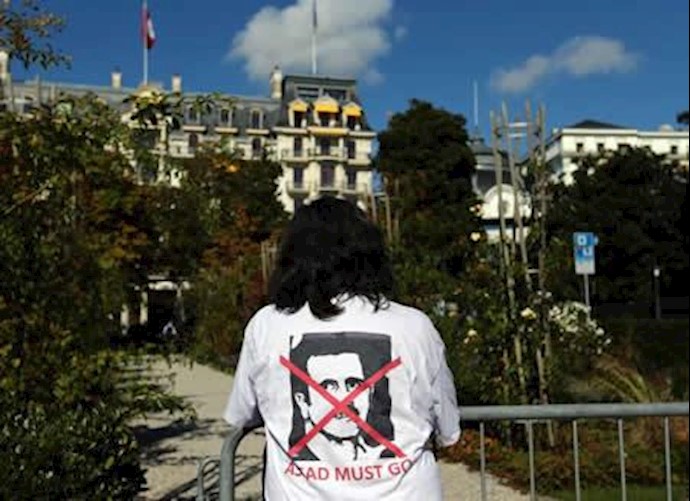
A woman stands outside the Beau-Rivage Palace ahead of Syria talks in Lausanne, Switzerland, October 15, 2016. The T-shirt reads: ‘Assad must go’. REUTERS/Denis Balibouse
Kerry hosted Russian Foreign Minister Sergei Lavrov and seven foreign ministers from the region – from Iran, Iraq, Saudi Arabia, Turkey, Qatar, Jordan and Egypt – weeks after the collapse of a painstakingly crafted U.S.-Russian ceasefire plan that many saw as the last hope for peace this year.
Kerry told reporters there was consensus on a number of options that could lead to a ceasefire, but conceded that there had been some tense moments during Saturday’s talks.
“I would characterize this as an example of what we wanted, which was a brainstorming and a very candid first-time discussion,” he said. “A number of ideas came from the number of different ministers as we hoped that might be able to shape some different approaches.”
But the meeting failed to come up with a joint statement or a shared vision on how to move forward.
Lavrov, who had said he had “no special expectations” for Saturday’s meeting, said ministers had discussed several “interesting ideas”, without elaborating.
Europe was not represented at the meeting, held in a luxury hotel on Lake Geneva. But France’s Foreign Ministry confirmed that Kerry and foreign ministers of like-minded nations planned to meet in London on Sunday to discuss Syria.
Kerry said parties to the Lausanne talks would contact each other on Monday to follow up.
Since the breakdown of U.S.-Russia cooperation, long the backbone of efforts to end the war in Syria, U.S. officials have worked on a number of ideas.
Although no breakthrough had been expected on Saturday, a senior U.S. official said before the meeting that the regional format to the talks could be the basis of a new process.
However, a former Western envoy in Syria told Reuters: “I don’t understand (why) the Americans are asking the Russians to talk again. They have made zero concessions. Do the Americans believe Moscow was shaken by the break-off last week and will change behavior now?”
Separately, a Western diplomat in Lausanne said the meeting appeared ill-prepared and vague in its goals, and the list of invitees had been clarified only at the last moment.
Earlier, Kerry met separately with his Saudi counterpart Adel al-Jubeir and with Lavrov to discuss the logistics of the meeting.
It was the first meeting between Kerry and Lavrov since the collapse of a second attempted ceasefire in September. The impending end of the Obama administration is likely to mean a hiatus in U.S. diplomacy while his successor, whether Donald Trump or Hillary Clinton, takes up the reins.
ACCUSATIONS
At the same time, pressure is rising for a halt to a ferocious, three-week-old Syrian government offensive to capture the eastern zone of the city of Aleppo, where the United Nations says 275,000 civilians still live and 8,000 rebels are holding out against Syrian, Russian and Iranian-backed forces.
Western powers have accused Russia and Syria of committing atrocities by bombing hospitals, killing civilians and preventing medical evacuations, as well as targeting an aid convoy with the loss of around 20 lives.
Syria and Russia counter that they are only targeting militants in Aleppo and accuse the United States of breaking the ceasefire by bombing scores of Syrian troops fighting Islamic State insurgents, over which the United States has expressed regret.
A senior rebel commander said on Friday that Syrian government forces would never be able to capture Aleppo’s eastern sector.
The United Nations has said food, fuel and medicine are running out in eastern Aleppo and there will be no rations to distribute from the start of next month.