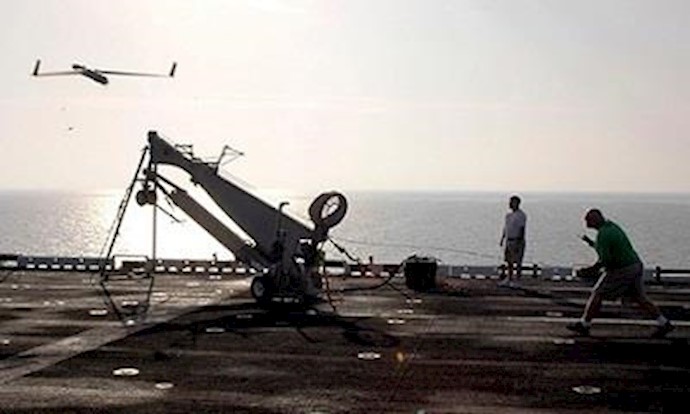
US spy drone given to prove Iran’s forces have mass produced the drone they claim to have captured a year ago
Guardian, 21 Oct 2013 – Iran has given Russia a copy of a US ScanEagle drone as proof that its elite forces have reverse-engineered and mass produced the American unmanned aerial vehicle they claim to have captured a year ago.
Iranian news agencies reported on Monday that the US spy drone was provided to Russia on the sidelines of a meeting in Tehran between Farzad Esmayeeli, the air defence commander of Khatam al-Anbia, the revolutionary guards’ military and industrial base, and the commander-in-chief of the Russian air force, Viktor Bondarev.
In December 2012, a guards’ commander said his forces had got their hands on a US ScanEagle unmanned drone, promising Tehran would mass produce the aircraft. The US authorities denied those claims at the time, saying all its unmanned air vehicles were fully accounted for.
“The drone built by the Islamic republic’s revolutionary guards is a symbol of the technical capabilities of the Islamic Iran and today we presented a real model of it as a gift to Russian air force commander Lieutenant General Viktor Bondarev and the Russian people,” Esmayeeli said after meeting with Bondarev, according to the semi-official Fars news agency.
Iran’s state English-language newspaper, Tehran Times, said that the two men met on Sunday in Tehran and spoke on a range of air defence issues including “radar” and “missile” systems but it did not give further details.
Iran first claimed to have captured a US drone two years ago when the revolutionary guards displayed an unmanned aircraft, believed to be an RQ-170 Sentinel drone. They claimed to have brought it down electronically but the US said the aircraft had merely malfunctioned.
Since then, Iranian officials have claimed advances in drone technology and have put on show a number of US and Israeli drones their elite forces allege to have shot down. Hezbollah’s leader, Hassan Nasrallah, said last October that a drone shot down by Israel was assembled in Lebanon but designed in Iran.
It is unclear how much the Iranian claims about its drone capabilities are reliable. Last September, the guards unveiled Shahed-129 (or Witness-129), an “indigenous” reconnaissance drone, alleged to have a range of up to 2,000km – capable of reaching Israel – with the ability to fly for 24 hours.
Iran’s state-run television earlier this year broadcast a programme showing video footage and still images the authorities claimed were extracted from the RQ-170 surveillance drone they captured in 2011. The TV programme also showed pictures of what was described as a ScanEagle drone production line in Iran.
Fars news agency described ScanEagle as a “small”, “long-endurance” unmanned aircraft.
“As standard payload ScanEagle carries either an inertially stabilized electro-optical or an infrared camera,” Fars said. “The gimbaled camera allows the operator to easily track both stationary and moving targets, providing real-time intelligence.”
Russia has infuriated the Iranian military in recent years for its failure to deliver Tehran with S-300 air defence systems it had agreed in a 2007 contract to supply but abandonded in 2010 due to international sanctions against the Islamic republic. In response, Iran filed a suit against Russia with the International court of Arbitration but said in June 2013 that will drop the case if Russia changed its decision.
Earlier this month, Iran’s foreign ministry spokeswoman, Marzieh Afkham, said talks were underway between Tehran and Moscow over the S-300 systems. A spokesman for the Russian president denied in September that Vladimir Putin had ordered the delivery of the air defence systems.