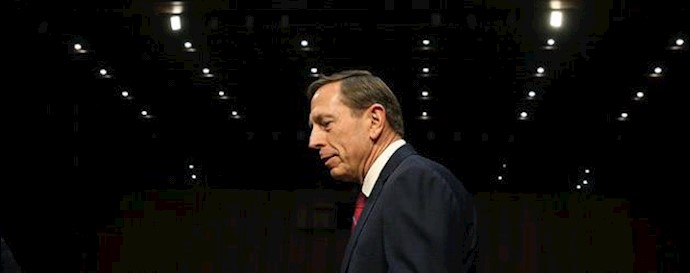
David H. Petraeus told Congress on Tuesday that the United States should establish enclaves in Syria where a moderate rebel force could operate and where displaced Syrians could find refuge, The New York Times reported.
Mr. Petraeus also suggested that the United States take military action to stop the barrel-bomb attacks that Bashar al-Assad has carried out against Syrian towns and cities, and urged that steps be taken to strengthen the military effort against the Islamic State group in Iraq.
Before his time at the C.I.A., Mr. Petraeus was a four-star Army general who headed the American-led coalition in Iraq and Afghanistan and was in charge of the United States Central Command, which oversees American troops in the Middle East. His recommendations to Congress go far beyond the steps the White House, which has been cautious about using military power in Syria and Iraq, has embraced.
Mr. Petraeus argued in his testimony that it was important to pursue a diplomatic solution to the Syrian conflict. But he asserted that the Obama administration had failed to take military steps that would put pressure on Assad and facilitate a political resolution to the bloody conflict.
“It is frequently said that there is ‘no military solution’ to Syria or the other conflicts roiling the Middle East,” Mr. Petraeus told the Senate Armed Services Committee. “This may be true, but it is also misleading. For, in every case, if there is to be any hope of a political settlement, a certain military and security context is required, and that context will not materialize on its own. We and our partners need to facilitate it — and over the past four years, we have not done so.”
A Pentagon program to train and equip Syrian rebels has failed to attract many recruits, largely because the goal is to train Syrians to fight the Islamic State, also known as ISIS or ISIL, and not the Assad government.
By establishing enclaves within Syria and taking action to stop the Syrian government’s barrel-bomb attacks, Mr. Petraeus asserted, the United States could attract substantially more support from Sunnis, a repressed majority in the country. That would produce a counterweight to the Syrian government and the Islamic State, and put pressure on the government to agree to a political settlement, he said.
“The central problem in Syria is that Sunni Arabs will not be willing partners against the Islamic State unless we commit to protect them and the broader Syrian population against all enemies, not just ISIS,” Mr. Petraeus said. “That means protecting them from the unrestricted warfare being waged against them by Bashar al-Assad, especially by his air force and its use of barrel bombs.”
“I would also support the establishment of enclaves in Syria protected by coalition air power,” he added, “where a moderate Sunni force could be supported and where additional forces could be trained, internally displaced persons could find refuge and the Syrian opposition could organize.”
In Iraq, where the fight between the Islamic State and the American-based coalition is at an impasse, Mr. Petraeus suggested several steps to strengthen the military effort, including embedding American advisers with Iraqi forces at the brigade level and exploring the use of American teams to call in airstrikes on behalf of Iraqi forces.
He also recommended moving the American headquarters that is overseeing the fight against the Islamic State to Baghdad from Kuwait, so the commander would have more opportunity to interact with the United States ambassador in Iraq.
“We are not where we should be at this point,” he said, referring to the military effort in Iraq. “In my judgment, increased support for the Iraqi Security Forces, Sunni tribal forces and Kurdish pesh merga is needed, including embedding U.S. adviser elements to the brigade headquarters level of those Iraqi forces fighting ISIS.”
As director of the C.I.A., Mr. Petraeus proposed that the Obama administration mount a covert program to train and arm moderate Syrian rebels. After considerable delay, President Obama approved the effort.
That program, and the Pentagon’s parallel effort to train and arm Syrian rebels to fight the Islamic State, has failed to significantly change the course of the Syrian conflict. The Islamic State, not the Syrian moderates the United States supports, has emerged as the major rebel fighting force in Syria. But Mr. Petraeus indicated that he thought training Syrian rebels was a worthy goal that had not been carried out effectively by the Obama administration.
Mr. Petraeus said the United States must be prepared to push back against Iran’s support for the Assad government and for extremist militias in the Middle East — a point that Mr. Obama also made in arguing for the nuclear accord with Iran.
“The most immediate test for the credibility” of the United States’ policy to contain Iranian power in the wake of that deal, Mr. Petraeus said, “will be what we do in Iraq and Syria.”
“No one is more conscious of the costs of military intervention, and of the limits of our military power, than I am,” he said. “But inaction can also carry profound risks and costs for our national security.”