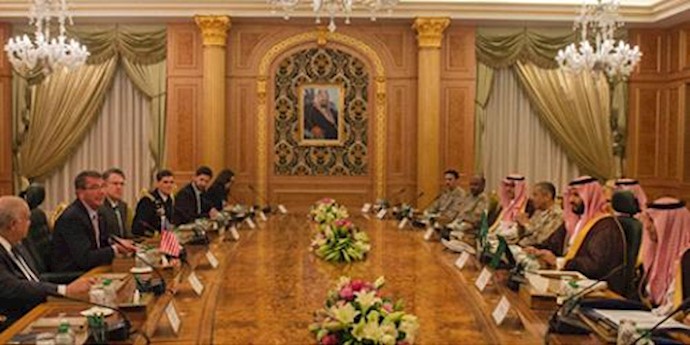
RIYADH- The United States is seeking greater special forces and naval cooperation with the Gulf states to counter Iran’s “destabilizing activities” in the region, a senior American official said. Defense Secretary Ashton Carter, who arrived in the Saudi capital yesterday, will meet his Gulf counterparts today. The following day he is expected to join President Barack Obama at a summit with monarchs of the six Gulf Cooperation Council states.
They will gather in an atmosphere of tension with regional leaders offended by Obama’s perceived reluctance to get involved in the region’s problems, and in particular his tilt towards Iran. The Gulf States are worried after the lifting this year of international sanctions against their regional rival, Iran, under an international agreement to curb Tehran’s nuclear program.
Riyadh and its neighbors fear the US-supported deal will only embolden Iran which they accuse of interference throughout the Middle East.
Over the past 15 years the US has sold combat aircraft to Gulf states, but the senior American defense official said Iran’s activities “won’t be countered” in that way. Rather, “special operations forces and maritime interdiction” are needed, he said.
The US is proposing to help train Gulf special forces and to develop their naval capacity to prevent Iran from supplying Shiite groups that it supports in the region, the official said. In “just over a six month period we and our coalition partners were able to interdict four weapon shipments off the coast of Yemen”, he said.
Meanwhile, the US government is poised to approve two long-delayed sales of Boeing Co fighter jets to Qatar and Kuwait, and could announce the multibillion-dollar deals during Obama’s visit, according to two sources familiar with the matter. Both deals have been stalled amid concerns raised by Israel that equipment sent to Gulf states could fall into the wrong hands and be used against it, and by the Obama administration’s broader decision-making on military aid to the Gulf.
However, the Pentagon and the State Department both have signed off on the sale of some 36 F-15 fighter jets to Qatar and 24 F/A-18E/F Super Hornets to Kuwait, both built by Boeing. The White House is expected to follow suit shortly. The sale to Kuwait is worth about $3 billion and the one to Qatar is probably close to $4 billion, sources familiar with the matter said. “The last hurdle now is getting approval from the National Security Council and the White House,” said one of the sources. The Pentagon had no immediate comment.
A senior Obama administration official said it was the administration’s policy not to comment on potential arm sales until it has formally notified Congress of an intent to sell something. But, the official said, the United States is committed to the security and stability of the Gulf region and defense sales “fit into the overall US regional diplomatic strategy”.
Senior US officials, including Navy Secretary Ray Mabus have publicly urged approval of the weapons sales, which will help maintain production of the fourth-generation Boeing fighter jets, while the newer and more advanced Lockheed Martin Corp F-35 fighter jet enters service in coming years. One senior US defense official said the Pentagon is keen to see the Boeing F-15 and F/A-18 production lines in St Louis continue and does not want to “foreclose any options on fourth-generation aircraft at this point”.
Boeing already is spending “hundreds of millions” of dollars to buy long-lead materials such as titanium to prepare for a possible Kuwaiti order for F/A-18E/F Super Hornets and a separate US Navy order for 12 jets put on the service’s “unfunded priorities” list submitted to Congress.
Source: Kuwait Times, April 20