The New York Times, Baghdad, April 6, 2010 — Deadly blasts shook Baghdad for the second time in three days on Tuesday, deepening fears that Iraq was teetering on the edge of a new outbreak of insurgent and sectarian violence, officials said.
At least seven bombings of residential areas of the capital, both Shiite and Sunni, killed 35 people and wounded more than 140. The violence came against a backdrop of continuing political instability after March 7 parliamentary elections rendered a fractured result that has left no single group with the ability to form a government, forcing a scramble for coalitions.
A similar political void after the 2005 parliamentary vote sparked months of violence and preceded Iraq’s bloody sectarian warfare of 2006 and 2007, from which the country has only begun to emerge.
There are also new concerns that the country’s Army and police may drift back into sectarianism amidst the political tumult.
“The security forces have lost direction,” said Baha al-Araje, a Sadrist member of Parliament. “They don’t know what will become of them. They are scared they will lose their positions if the government changes. What we need now is a kind of selflessness among all the blocs to quickly form the next government.”
The explosions on Tuesday came after at least 30 people were killed and more than 240 were wounded during attacks Sunday on diplomatic buildings in Baghdad, including the Iranian Embassy.
On Tuesday, Qassim Atta, spokesman for Baghdad’s security network, said the violence represented a war in which insurgents connected to Al Qaeda in Mesopotamia were seeking to destabilize Iraq amid its post-election confusion. In the past, Iraqi and American officials have said that the Sunni insurgent group had been all but routed.
“We are in a state of war with what remains of Al Qaeda,” he said.
The bombings hit Baghdad from its southern tier to its northwestern outskirts, beginning about 9 a.m. and continuing until about 11:30 a.m., Mr. Atta said.
At least five of the bombs were homemade devices placed inside apartment buildings, an unusual tactic. In recent months, insurgents have focused on attacking Iraqi and American security force members, Iraqi government officials and Westerners. A parked car packed with explosives was also detonated in a Shiite neighborhood in south Baghdad.
Mr. Atta said at least two other explosives had been successfully defused by Iraqi security forces.
In at least two cases, an apartment or store in one of the buildings attacked Tuesday had been rented out in recent days by men who had paid unusually large sums of money, according to people who live in the neighborhood.
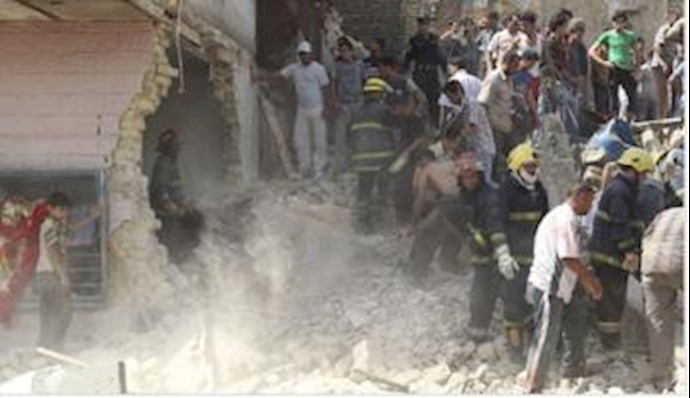
At an apartment building in Shuala, a neighborhood in the city’s northwest, a chaotic scene followed an explosion at an apartment building as dozens of people came to the scene to help. Men got on their knees and dug out collapsed bricks and chunks of cement to free anyone who might have been trapped.
As American helicopters circled overhead, women shouted out the names of loved ones.
“I saw one woman being pulled out of the collapsed building and about five others who had been injured,” said Hussein al-Marsumi, 48, a laborer. “They were screaming and covered with blood and dust. They looked like they had been buried in their graves.”
Violence during the past several days has also claimed the lives of an extended family of 25 Sunni Arab men and women who had their hands bound before they were shot or had their throats slit in a village south of Baghdad on Friday. Their killers wore uniforms that resembled those of United States and Iraqi military and security forces.
On Monday, a family of six Shiite Arabs, including four children — one was a 4-year-old boy — were shot and killed in Wasit Province east of Baghdad.
American officials in Iraq said Tuesday afternoon that they had not been asked by the Iraqi government for assistance.
Gary Grappo, the United States Embassy’s adviser for political affairs, agreed that the attacks bore the hallmarks of a Qaeda organization seeking to display its ability to strike at will.
“They probably felt quite frustrated by their failure to disrupt the election and felt a compulsion to show that they are still here,” said Mr. Grappo. “They appear unable to go after the heavily secured targets they’ve attacked in the past so now they’re going after targets that have relatively little security, and sadly, that means defenseless civilians.”
Prime Minister Nuri Kamal al-Maliki has made no public statements about the spate of attacks, though he held a meeting with his top security officials on Sunday about the violence.
Mr. Maliki’s political organization, the State of Law alliance, won 89 seats in last month’s Parliamentary election, while Ayad Allawi’s secular Iraqiya coalition won 91 seats.
The groups have held competing talks with smaller parties during the past two weeks in an effort to form a larger coalition to win 163 of the 325 seats in Parliament needed to form a new government.
Although Mr. Maliki remains prime minister, his circle — like much of the rest of the country — appeared to be in disarray on Tuesday.
When asked about the bombings, Ali al-Dabbagh, Mr. Maliki’s chief spokesman, sought to distance the government from the attacks, even though the military officials responsible for securing the capital were appointed by Mr. Maliki and answer to him directly.
“Ask the military and whoever is responsible for the security situation,” said Mr. Dabbagh during a brief phone interview. “I have nothing else to say.”
Mr. Allawi had some of his harshest remarks yet about Mr. Maliki’s government.
“We want a government of partners that is functional, not like the one now that can not make decisions,” he said, speaking while donating blood for the injured. “They say they are a national government, but they are not.”
Mr. Allawi added: “The government keeps saying, ‘Let the Americans leave, we are prepared.’ What is prepared? The security forces are prepared? I’ve not seen any preparation.”
American combat troops are scheduled to leave Iraq by Aug. 31, and all United States forces are to have withdrawn from the country by the end of 2011.