MailOnline- 31 Aug. 2016- Iran is shoring up the Syrian regime from a secret HQ in Damascus nicknamed ‘the Glasshouse’ – and commanding a huge covert army in support of Assad, according to leaked intelligence passed by activists to MailOnline.
The National Council of Resistance of Iran (NCRI) claims that the theocratic state’s Supreme Leader Ali Khamenei has spent billions in hardware for its ally Bashar al-Assad in the last five years – and runs operations on the ground from a five-floor monolith near Damascus airport.
The Iranian HQ, which plays a pivotal role in supporting Assad’s regime alongside Russia, contains intelligence and counterintelligence operations, and has vaults packed with millions of dollars in cash flown in from Tehran, claims the NCRI.
The allegations are contained in a dossier of reports apparently leaked by senior sources inside Iran’s Revolutionary Guards and collated by the dissident activists who oppose the Iranian regime.
The dossier – which was described as ‘credible’ by intelligence experts – makes the bold claims that Iran controls the biggest fighting force in Syria; has military bases throughout the splintered state; and has amassed a war-chest far greater than feared in support of Bashar Assad.
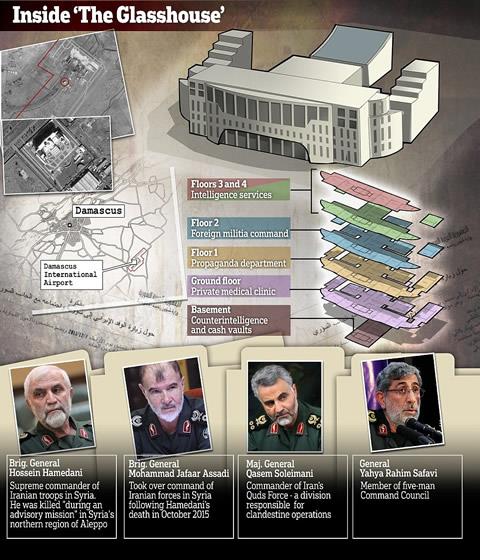
Opposition activists have claimed that Iran is waging a secret war in Syria from a giant HQ nicknamed ‘the Glasshouse’
The third and fourth floors are apparently occupied by the Revolutionary Guards’ intelligence unit, which is in overall command of the HQ. These areas are off-limits to even the most senior army officers.
On the ground floor there is reportedly a cafe and a 20-bed private clinic for wounded senior military personnel, while the first floor houses the Revolutionary Guards’ propaganda department, rest area and prayer rooms, the leaked intelligence says.
The basement contains the counterintelligence and logistics departments and is said to hold millions of dollars in cash.
When Revolutionary Guard soldiers arrive in Syria, the HQ apparently issues them a white card containing a special code, which is handed back when they leave.
If the activists’ claims are accurate, this would mean that the fundamentalist Tehran regime and its Shia proxies are far more powerful than has been estimated. Western analysts have so far placed the total Iranian-led Shia force at just 16,000.
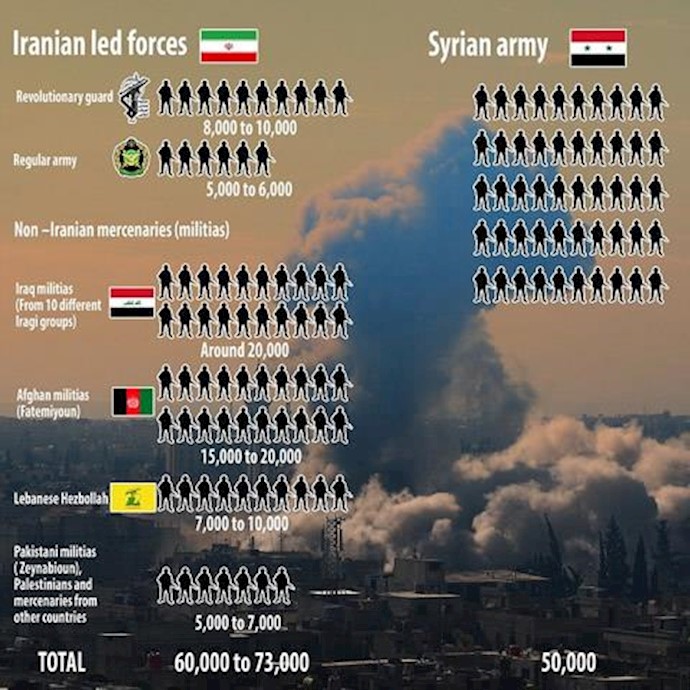
The dissidents make the claim that Iran now commands about 60,000 Shia troops in Syria – 15,000 more men than Britain took into the 2003 Iraq war – while Assad’s army has been reduced to just 50,000 soldiers.
In addition, the Lebanese militant group Hezbollah, which has an independent command structure but operates in close coordination with Iran, has about 10,000 troops in the country, they say.
The NCRI is the exiled Iranian opposition movement committed to the overthrow of the regime in Tehran. It has leaked intelligence about the regime in the past, in 2002, it sensationally exposed the existence of secret nuclear facilities at Natanz and Arak, in central Iran, which made Western powers more cautious in negotiating with Tehran.
The suggestion that Iran has so many soldiers on the battlefield – 16,000 Iranian troops commanding 45,000 Shia mercenaries from Iraq, Afghanistan, Pakistan, Lebanon as well as Palestinians and Baluchis, a minority group from Afghanistan – is likely to cause anxiety in the region and in the West, which is lifting sanctions on the regime after signing a controversial nuclear deal.
Kamal Alam, a research analyst at the Royal United Services Institute (RUSI), said that the leaked intelligence was ‘entirely plausible’.
‘I go quite regularly to Syria and visit the battlefields, and I’ve seen how the Iranians try to keep their operations as secret as possible,’ he said.
‘Their troops tend to speak Arabic rather than Farsi in public, and generally don’t wear Iranian uniforms. This makes it very hard for observers to know how many are in the country.’
Analysts have been forced to use conservative estimates of troop numbers, Alam said, because Tehran – which is wary of causing alarm both at home and abroad – does not release reliable figures.
In addition, Assad, who leads a secular administration, downplays Iran’s support to avoid the impression that he is a puppet of the Islamist regime, he said.
The key claim by the activists is that Iran operates a major HQ close to Damascus airport, which the NCRI say is nicknamed The Glasshouse (Maqar-e Shishe’i in Farsi).
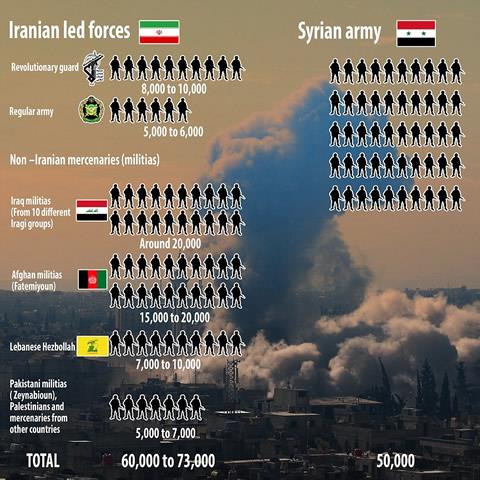
Activists have claimed that Iran now leads 10,000 more troops in Syria than Assad himself. If true, that would mean that it is at least 15,000 higher than the force Britain led into the 2003 Iraq war
The 180-room building is said to be positioned very close to an airstrip that the NCRI say is nicknamed ‘Muhammad Ali’, making it easy for Iranian military chiefs to receive deliveries of troops, cash and equipment – and to escape should Damascus fall.
Anti-blast walls form a square around the perimeter, which is guarded by heavily armed troops. According to the NCRI, up to 1,000 personnel work at the secret base, and all must undergo an intensive security screening.
A number of departments are based inside, including counterintelligence, logistics, propaganda and foreign mercenary command.
The Iranian intelligence services, who are in charge of the base, are said to occupy the top two floors.
The building is also said to contain prayer rooms, a 20-bed private clinic for wounded senior officers, and facilities for holding millions of dollars in cash, which are reportedly kept in the basement.
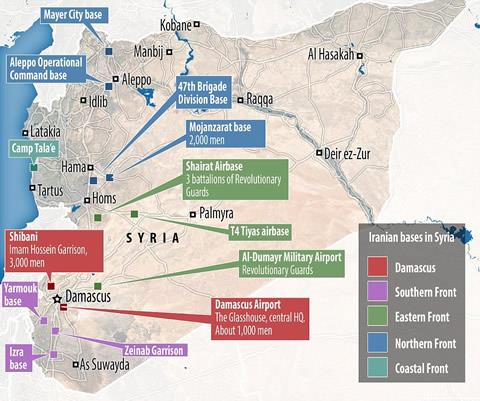
Activists claim Tehran has divided Syria into five ‘fronts’ with bases in 18 locations from the north to the south
WHY IS IRAN FIGHTING TO DEFEND ASSAD IN SYRIA?
Syria has long been considered an important ally of Iran, having been the only Arab country to have explicitly supported it during the Iran–Iraq War in the Eighties.
For Tehran, the main objective is to maintain its supply lines through Syria to its proxy Hezbollah in south Lebanon.
The intelligence passed to MailOnline claims that Tehran has spent a staggering $100billion on the conflict since 2011, including hardware and support for Assad’s regime.
The figure claimed by the NCRI has surprised Western analysts, who have so far estimated that Iran has spent just $15billion on the war in Syria.
Millions of dollars in cash is regularly delivered at the Iranian airstrip before being transferred to the HQ nicknamed ‘the Glasshouse’, the dissidents claim.
There it is allegedly stored in the basement under the auspices of head of logistics, Brigadier General Seyyed Razi Mousavi, formerly commander of the elite Quds Force in Syria, and is principally used to pay fighters’ salaries.
The revelations come after Tehran took the extraordinary step of allowing Russia to use its airbases to launch attacks in Syria, demonstrating its expanding role.
It also follows reports that Iran has deployed a Russian-made S-300 surface-to-air missile defence system at its uranium enrichment facility at Fordow, northwestern Iran.
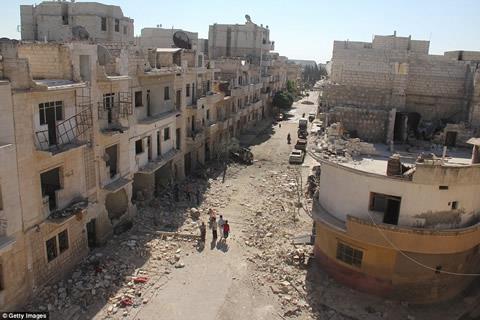
Streets are reduced to rubble by Russian planes in Idlib, Syria, in July.
Iranian forces are supported by Russian airpower
A Foreign Office spokeswoman told MailOnline: ‘Iran’s role in fostering instability in the Middle East, including ongoing support for proxy groups and the Assad regime, and the activities of the Quds force, remains a source of serious concern.’
The activists also claim Tehran is putting down military roots in 18 locations from northern to southern Syria, showing how it intends to control large swathes of the country even if Assad is defeated.
Iranian military planners – acting under Brigadier General Mohammad Jafaar Assadi, the recently appointed supreme commander of Iranian forces in Syria – are said to have divided Syria into ‘five fronts’, comprising the Northern Front, Eastern Front, Southern Front, Central Command Front and Coastal Front, the NCRI claims.
Revolutionary Guard bases have been established in each of the sectors, which the NCRI says can accommodate up to 6,000 troops, as well as heavy weapons, air power and anti-aircraft missiles.
Experts say Tehran is determined to protect and defend its supply lines to its ally Hezbollah in southern Lebanon, and expand outwards from this core territory.
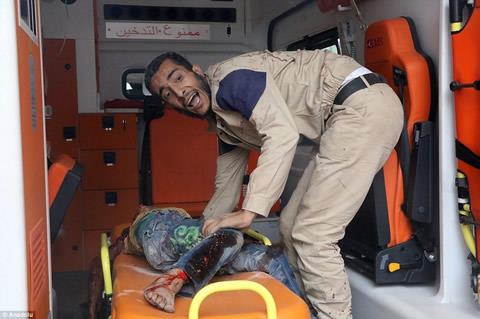
A wounded boy lies in an ambulance after Assad’s forces attacked the Ansari neighborhood of Aleppo in July
One security source told MailOnline: ‘Iran is getting itself into a position where whether Assad stands or falls, Tehran is in the best position to dominate whatever comes next.’
Such is the scale of Tehran’s involvement in Syria that the war has been taking its toll domestically, the dossier claims. Last year, just 5,000 Iranians were in action in the country; today, this number stands at 16,000.
Security sources have reported growing levels of public unease in Iran at the level of casualties sustained. In response, Tehran has presented the conflict as the front line in a war against terrorism, which if not confronted abroad, would threaten Iran at home.
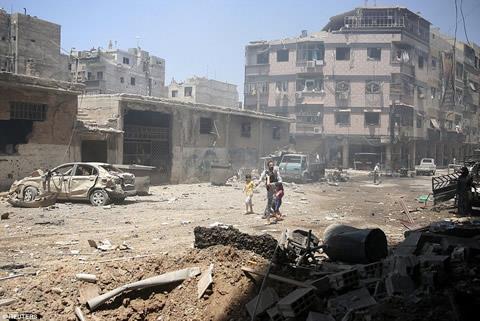
Civilians walk past damages at a site hit by airstrikes in the rebel-held Douma neighbourhood of Damascus in July
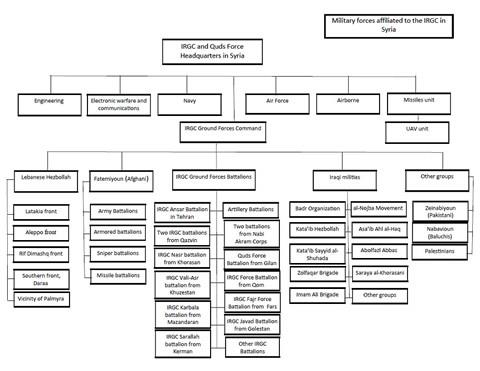
A page of the leaked dossier claiming to reveal the secret command structure Iranian-controlled forces in Syria
The new intelligence on Iran’s military presence in Syria contains important revelations confirming the general picture experts are familiar with. Most significant is the scale of Iranian-backed forces, some 60,000 men. The majority are Shia irregulars, mainly from Afghanistan and Pakistan.
The Afghans are refugees who have been offered accelerated naturalisation for fighting in Syria. The Pakistanis are all also Shia. Together these forces provide what remains of Assad’s highly mechanised army with light infantry capabilities essential to intense urban warfare against predominantly Sunni rebels.
The dossier also provides important insights into the command structures the Iranian Revolutionary Guards have in place, notably at the ‘Glasshouse’ headquarters near Damascus airport. It also adds to what is known about operations commanded by Major General Qasem Soleimani, the elusive face of wider Iranian subversion in the regional struggle for dominance with Sunni Saudi Arabia and some of its smaller Gulf allies.
He has recently vowed that once the Revolutionary Guards have finished off ISIS in Iraq and Syria, it will help liberate the Shia majority of Bahrain from its Sunni monarchical oppressors.
Both Iran and Syria have good reasons to keep this deep presence secret. Iran’s clerical regime does not want to advertise its involvement on this scale because the Iranian public has had a bellyful of costly wars, with hundreds of thousands of dead from the 1980-88 war against Iraq.
Moreover, most Iranians expect a dividend from the P5+1 nuclear deal with the West, China and Russia, with maybe $100billion in bank assets abroad being unfrozen.
If this dossier is right in claiming that the war has cost Iran $100 billion since 2011, then there won’t be much of a ‘dividend’ at all. A death toll of around 1,500 men in Syria is also causing problems for Hezbollah in its southern Lebanese heartlands.
The predominantly Alawite Assad regime in Syria (the Alawites, often seen as a Shia sect, comprise a minority of Syrians) is fighting to reassert its control over the entire country, with its far larger numbers of Sunnis.
Assad cannot afford to be viewed as a puppet of Tehran, which would only exacerbate the sectarian nature of the conflict. That is why posters of Russian rather than Iranian commanders figure in Damascus, for the Russians bring no sectarian baggage to the conflict along with their air power.
Yet the role of Iran goes even further, according to activists, who also claim that the state stepped in to encourage Russia to commit significant resources to bolster Assad in 2015.
Tehran is said to have acted in August that year, when after huge losses in Aleppo, Idlib and Dera’a, it seemed likely that Assad would fall.
During a secret meeting with Moscow in July last year, Major General Qasem Soleimani apparently requested greater Russian air support and a huge shipment of weapons, including MiG, Sukhoi and Antonov aircraft, Kamov and Mil helicopters, and T90 tanks.
Dissidents citing Revolutionary Guards sources claim that a deal was done on condition that Iran paid $3billion towards the $10billion cost.
‘You’re talking about a very orchestrated, emboldened and well-planned Iranian presence,’ one security source told MailOnline. ‘They are thinking very clearly and wisely, and are putting down deep roots, creating pockets of power in places with strategic importance.
‘The Iranians are masters in meddling in different political functions abroad. It is exactly what many in the region are afraid of. It’s their biggest nightmare.’
A Foreign Office spokeswoman said: ‘The Iranian government has said that it wants to see a peaceful solution to the Syrian conflict. But as thing stand, Iran is a long way from playing a constructive role.
‘Iran continues to send fighters, including the Revolutionary Guards Quds Force, to Syria, subsidises the Assad regime and is actively supporting the Assad regime’s suppression of innocent people.’