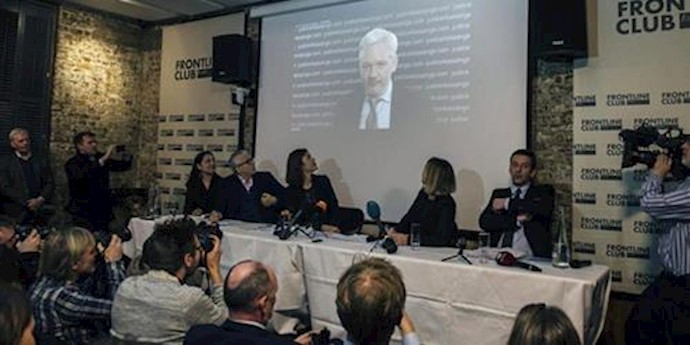
WikiLeaks founder seeks to secure freedom to walk out of embassy in London without fear of arrest for rape allegations.
Al-Jazeera, 05 Feb 2016 – WikiLeaks founder Julian Assange has hailed a “significant victory” after a UN panel found that the hacker – who has been hiding in Ecuador’s embassy in London since 2012 to avoid extradition to Sweden to face rape allegations – is “arbitrarily detained”.
Assange said on Friday that it was “now the task of the states of Sweden and the United Kingdom as a whole to implement the verdict” by letting him walk free from the embassy.
“We have today a really significant victory that has brought a smile to my face,” Assange said, addressing a press conference via a video link from the embassy
Both Britain and Sweden denied that Assange was being deprived of freedom, noting he had entered the embassy voluntarily. They also dismissed the non-binding legal opinion of the UN panel.
Britain’s Foreign Secretary Philip Hammond called Assange “a fugitive from justice”. “This is frankly a ridiculous finding by the working group and we reject it,” he said.
Melinda Taylor, a lawyer representing Assange, told Al Jazeera from London that she and her client were “obviously very disappointed” by the response of Hammond.
“We find it extremely surprising that the United Kingdom would say international law is ridiculous or that the United Nations charter is ridiculous and if they would disregard the obligations under binding convention such as the international covenant or the convention against torture in this case,” she said.
The UN Working Group does not have the authority to order the release of a detainee – and Friday’s ruling in unlikely to change the legal issues facing Assange – but it has considered many high-profile cases and its backing carries a moral weight that puts pressure on governments.
Al Jazeera reporting from London, said: “Perhaps one positive outcome that may come from today’s events is that the British, Ecuadorian and Swedish governments behind the scenes will feel a renewed pressure to come to some kind of a discreet diplomatic solution.”