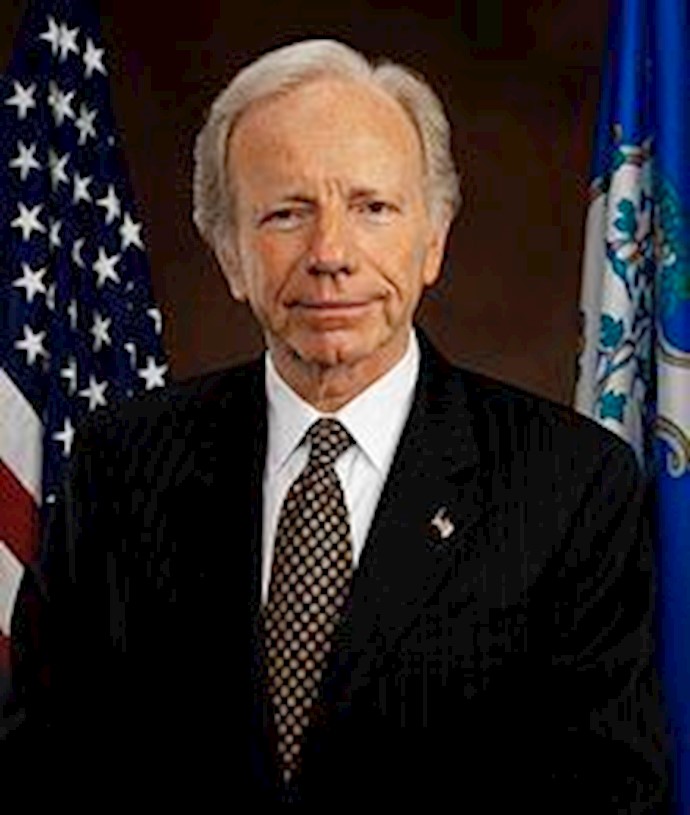
In an article published in the Indian Express on June 19, 2016, former US Senator, Joseph Lieberman warns Indian government of not falling for a petty interest in dealing with the terrorist sponsor regime of Iran. The article explains that financial and economic relations with the mullahs’ ruled Iran, would rob any country of real and tangible benefits of doing business with the rest of the world.
Senator Lieberman explains that Iran’s long cold war with Saudi Arabia has become hotter in recent times, evidenced by the ransacking of the Saudi embassy in Tehran and the ongoing wars in Syria and Yemen. The international community cannot afford to take its eye off Iran and Hezbollah—whether they are threatening Israel or Saudi Arabia. This past month, a senior adviser to Iran’s Quds Force warned that Iran could wipe out Israel “in less than eight minutes”. Iran also continues to host high-level delegations from terrorist organizations which endanger many of America’s allies. Iranian Supreme Leader Khamenei and Hezbollah Secretary-General Nasrallah view Israel and Saudi Arabia as two sides of the same coin.
Hezbollah’s heavy involvement in Syria on behalf of the Assad regime has provided the terrorist organization with new weaponry and sophisticated logistics and tactical training from both Iran and Russia, making it more dangerous.
Syria is one of many theatres where Iran has employed its aggression. Tehran has been President Assad’s chief enabler—deploying Islamic Revolutionary Guard Corps personnel, funding, material, and Shiite militias to prop-up his illegitimate regime. Even while ceasefire talks were underway in February, Iran increased its involvement in every aspect of the conflict on behalf of Assad. Its Basij forces have actively recruited volunteers in major cities in Iran—under the guise of defending Shiite shrines—for service in Syria. We also see a newfound confidence on the part of the Assad regime—in no small part due to Iran’s support—as evidenced by the President’s recent vow to reclaim “every inch” of Syria. Thus, Iran isn’t the solution to the Syrian quagmire; it is the problem. One of the worst consequences of Iran’s support of Assad is the emergence of the Islamic State, a radical terrorist group that has asserted its sovereignty over much of Syria and Iraq, and is now coordinating and inspiring terrorist attacks against people throughout the world.
It is in the light of the above issues that the India-US ties assume huge significance. As a former US Senator, I can tell you that the relationship is natural and important for both nations. During his recent visit to Washington, PM Narendra Modi told the Congress that India’s cooperation with the US “secures our cities and citizens from terrorists, and protects our critical infrastructure from cyber threats”. It’s for these reasons that India’s formidable economic and diplomatic power should not be used to further embolden the Iranian regime, which has only doubled down in its regional meddling and support for terrorism in the aftermath of the nuclear deal.
In Iran, business is routinely intertwined with terrorism. Therefore, if Indian companies sign deals with Tehran, they will be lending support to its belligerent behavior. If PM Modi is concerned about protecting critical infrastructure from cyber threats, he should note that the US Justice Department has charged seven Iranians linked to the regime with launching cyber-attacks against the US financial sector and critical infrastructure, including a dam outside of New York City. Indian companies, as much as their American counterparts, are vulnerable to cyber-attacks by Iran.
Pursuing business in Iran can also lead to losing out on more lucrative opportunities in countries that oppose its hegemonic policies. For instance, India has the choice to invest in the US, Britain, France, Germany, Japan, Saudi Arabia, Kuwait, UAE, other GCC countries, and allied countries with a combined GDP of over $32 trillion, or take a gamble on Iran’s economy with a GDP of under $400 billion. There is a real risk that Indian companies investing in Iran will lose market share in some of these other countries.
So, while Iran could help alleviate India’s energy problems, there are better ways to solve those. Doing business with the regime can create even more problems for New Delhi—economically, diplomatically, and in terms of security.
Joseph I Lieberman Former US Senator and chairman of United Against Nuclear Iran