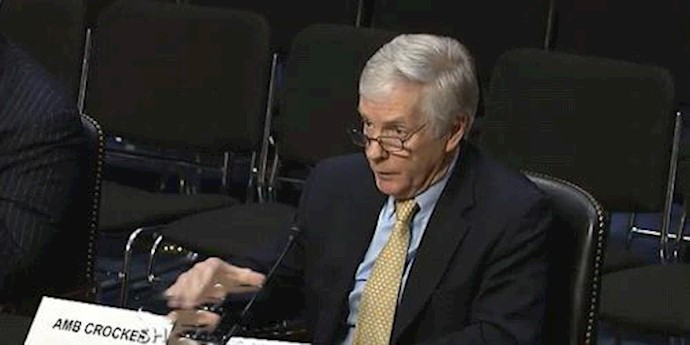
Ambassador Ryan Crocker testified Wednesday, January 20, 2016 before the Senate Arms Services Committee describing the US Strategy and Policy in the Middle East.
During this lengthy testimony, Ambassador Crocker said:
“Almost every state in the region has been touched with conflict. Syria, Libya, and Yemen are completely failed states. Iraq is on the edge if not over it, and Afghanistan is threatened. And as bad as things are today, the trend lines all point down – it will be worse tomorrow.
“As states fail, non-state actors emerge. Islamic State and the various franchises of al-Qaida are present through much of the region and beyond – Boko Haram and al-Shabab in Africa, affiliates in Indonesia and elsewhere. Violent Shia militias are operating in Iraq and in Syria. Unlike Sunni terror groups, the Shia have a state sponsor – Iran.
“These developments have implications for global as well as regional security. As my friend and former wingman Dave Petraeus has said, what happens in the Middle East does not stay in the Middle East. Islamic State terror attacks in November in Paris are a horrific illustration. The worst refugee crisis since World War II affects more than the millions of refugees themselves. It has weakened the leader of one of our best NATO allies, Germany.
“The committee’s invitation to testify noted a number of important topics. I will try to provide some perspectives on them.
“IRAN:
This past week has been an extraordinary one for the U.S. and Iran. We witnessed the capture and release of American sailors, the implementation of the Joint Comprehensive Plan of Action (JCPOA), and an exchange of prisoners. There is speculation that after more than 35 years of hostility, our two countries might be moving toward a rapprochement that could reshape the Middle East. We are not.
“The first steps have been taken; now we must turn to rigorous verification of continued Iranian compliance. At the same time, we need to bear in mind that it is a multilateral arms control agreement, not a treaty of friendship. I am reminded of the arms control agreements we negotiated with the Soviets in the 1980s. They made the world a safer place, but they had no impact on the broader confrontation between the free world and the Soviet Union – the evil empire.
“Similarly, we welcome the release of the American hostages and their return to their families. They never should have been held in the first place. In the early 1990s, I was the American ambassador to Lebanon when our hostages there came home. The Syrian government played a significant role in their release, for which it was thanked. However, the Syrian government, along with Iran and Hizballah, also had a significant role in their detention, and the releases did not transform the relationship. Syria remained on the list of state sponsors of terror.
“This is a transactional relationship, not a transformational one. As a former diplomat, I think it’s good to have a number to call at critical moments. But we have to be clear eyed about Iran’s role in the region.
“We must vigorously confront malign Iranian activity in the region. In Iraq, Iranian support for vicious Shia militias, some of them commanded by individuals implicated in the murder of American servicemen, has weakened Prime Minister Abadi and deepened sectarian divisions.
This has allowed Islamic State to take root and brought the Iraqi state to the point of failure. In Syria, Iran’s Revolutionary Guards are fighting alongside Hizballah and Assad’s forces as they murder Syrian civilians under Russian air cover and force millions from their homes. Nor should we think of Iran as an ally against Islamic State. Iran and its proxies along with Russia are in Syria to bolster Assad, not fight Islamic State. They are in Iraq to weaken the state and assert their own direct and indirect control. Islamic State is an excuse for the Iranians, not an enemy.
“I was recently in the Middle East and was struck by the extent to which many Arab friends perceive not only a Damascus – Tehran – Moscow axis that is anti-Sunni and anti-Arab, but also that the U.S. has tilted away from its traditional Arab allies in favor of Iran. We are absent in Iraq. We deconflict air space in Syria with the Russians. We bomb Islamic State targets in Sunni areas while doing nothing to prevent Assad from using his bombs to kill Sunni civilians. Perceptions are their own reality, and these perceptions are becoming dangerous for our broader interests.
“So in a chaotic Middle East that Iran has done much to make so, this is a time to make clear that we stand with our friends – Saudi Arabia and the Gulf States, Israel, Turkey, Jordan, and Egypt. All have important concerns over Iran and its behavior. We have differences with some, especially over Yemen, but this is a moment to forge a common cause. Iran has been pushing very hard in the region to advance its violent agenda. We need to push back. We have managed some important transactions with Iran, but it is not a transformation.
“ISLAMIC STATE, SYRIA AND IRAQ:
Over 18 months after Islamic State fighters swept through much of Iraq and 15 months after the U.S. and others began launching airstrikes against them, Islamic State is certainly not defeated. It is barely degraded. It has lost some ground in Iraq but gained in Syria, including the city of Palmyra. 50 Special Operations advisors working with predominantly Kurdish forces will not turn the tide.
“So what do we do? First, we must significantly ramp up coalition airstrikes against Islamic State. Recent targeting of Islamic State oil network is a good step, and it should be expanded. Simply put, we need to be all in with an air campaign that goes after their command and control and ability to conduct offensive operations. In short, to actually degrade the organization. But to ultimately defeat Islamic State and end this terrible conflict, we need to change the political context and to understand that for many Syrian Sunnis, Assad is a far worse enemy than Islamic State. In Syria, I have argued for a no-fly zone in the north and south. It would be a clear message that we stand with Syrian civilians against the savage bombings by Assad of his own population and against those who back him in Moscow and Tehran. Depriving Assad of the ability to murder his own people from the air would not mean his defeat, but it could change his calculations as well as those of Russia and Iran, “finally enabling a political process. It is an axiom that there is no military solution to the Syrian conflict. But military actions can shape the political environment. The Russian intervention did so negatively. A no-fly zone could reshape the context more favorably. According to the Institute for the Study of War, zones could be enforced without putting U.S. aircraft in Syrian airspace by a combination of Patriot and Cruise missiles and aircraft operating in Turkish and Jordanian airspace. With cooperation from these countries, no-fly zones could cover safe zones for civilians and serve as areas where face-to-face coordination with non-jihad opposition elements would be possible. Other measures would be to make the anti-Islamic State envoy a presidential envoy. This would demonstrate a seriousness of purpose on the part of the White House and give the envoy authorities he currently lacks. Reestablishing a deputy national security advisor to coordinate the anti-Islamic State campaign in Washington would serve the same end.
“I applaud the UN led effort to launch a political dialogue among Syrian factions. But it will go nowhere as long as Assad and his outside backers think he is winning. For there to be any chance of a serious negotiation, conditions on the ground must shift.
“IRAQ:
When I left Iraq in 2009, I could never have imagined how it looks today, even in my worst nightmares. During three decades in the Middle East, I learned two things. The first is be careful what you get into. Military interventions set in motion consequences to the 30th and 40th order that can’t be predicted, let alone planned for. The Soviet invasion of Afghanistan and the rise of militant Islam, the Israeli invasion of Lebanon and the rise of Hizballah, the American invasion of Iraq and the birth of al-Qaida in Iraq. The second thing I learned is to be just as careful over what you get out of. Disengagement can have consequences as great, or greater than those of the original intervention. In Iraq, we were not careful about either. Withdrawal of our forces and a virtual end to sustained political engagement in Iraq after 2010 did not end the war. It simply left the field to our enemies: Iran, its proxy Shia militias, and Islamic State. It is the coalition from hell: Iran and Islamic State do not seek each other’s destruction; both seek the disintegration of a unitary Iraqi state into a Jihadistan, run by Islamic State, an Iranian dominated Shiastan, and a Kurdistan heavily influenced by Iran. This is a threat to U.S. national security.
“In Iraq as in Syria, there is no military solution to Islamic State threat. The political chasm between Sunni and Shia have given Islamic State the space to fester. Iran has worked to sharpen those divides; and virtual U.S. absence over the last four years has given Iran, its proxies, and Islamic State the scope to act, and they have. The U.S. needs to reengage, not with military force but with sustained, high-level diplomacy led by the President and the Secretary of State. For many reasons, Iraqi leaders find it extraordinarily difficult to make the political compromises necessary to foster a broad sense of inclusion among all of Iraq’s communities. Iraqis cannot make the necessary deals on their own, but the U.S. can serve as an effective broker. We have done it before. Only when Iraqi Sunnis feel they have a secure and equitable place in the Iraqi state will the ultimate defeat of Islamic State be possible.
It is perhaps no coincidence that the most chaotic period in the history of the modern Middle East is also a time of the greatest U.S. disengagement since we stepped onto the regional stage after World War II. We certainly cannot fix all the problems of the Middle East. But U.S. leadership can make a difference. Our friends in the area are looking for us to lead and bear the consequences of our perceived lack of involvement. Without a larger U.S. role, an already impossible situation will only get worse. And it will come home to us.”