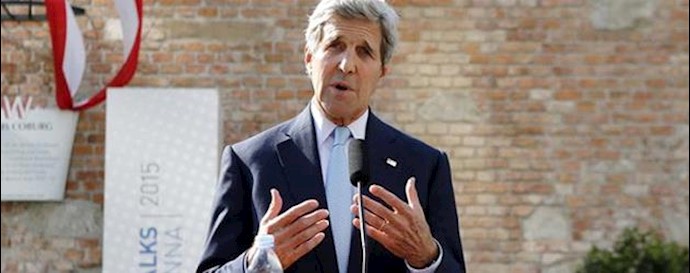
US Secretary of State John Kerry said on Thursday that the United States would continue to negotiate in pursuit of a nuclear agreement with Iran that could endure “for decades,” but cautioned that the talks would not be open-ended.
“We will not rush, and we will not be rushed,” Mr. Kerry said, appearing before reporters in front of the Palais Coburg hotel here, where the negotiations were underway.
“If the tough decisions don’t get made, we are absolutely prepared to call an end to this process,” he added.
The clashing assessments made clear that talks had not only failed to meet the Thursday deadline for submission to Congress for a 30-day review, but were also burdened by thorny issues and even some acrimony.
Explaining the decision to continue the talks, which have missed their June 30 deadline and have twice been extended since then, Mr. Kerry referred to a discussion on Wednesday night with President Obama. In it, it was decided that the strength of a prospective deal, which is meant to guarantee that Iran’s nuclear activities are peaceful, was more important than adhering to a rigid timetable
“All that we are focused on is the quality of the agreement,” Mr. Kerry said. “If in the end we are able to reach a deal, it has to be one that can withstand the test of time.
“It is not a test of a matter of days or weeks or months. It’s a test for decades.”
Mr. Kerry set no target date for completing the talks but echoed a statement he made last Sunday — at the same spot in front of the hotel — that Mr. Obama was ready to walk away if progress could not be made.
While the United States sought to put the onus on Iran, the Iranians’ strategy was to put the blame on the United States and attempt to fracture the coalition of six nations facing them across the negotiating table.
Though the current round of talks has dragged on longer than even some of the negotiators had expected, the Obama administration sees risks in walking away or even taking a lengthy break from the talks.
A senior administration official told reporters this week that if the talks were interrupted, the Iranian side might face political pressure at home to back away from elements of an agreement.
“It is pretty darn hard for the Iranians to go home and deal with the politics in Iran,” said the official, who spoke on the condition of anonymity under the ground rules for the briefing. “Everyone understands that once we leave here, we are in less control of what happens in this negotiation. It gets more complicated, not less complicated.”
Mr. Kerry’s wording about the enduring nature of the accord sought by the United States appeared to be an attempt to respond to one of the main criticisms of an emerging deal: that it does not constrain Iran nuclear capabilities for long enough
Some central provisions of the accord under negotiation, however, would not actually last for decades. Provisions that would extend to a year the amount of time Iran needs to produce enough nuclear material for a bomb would be in place for the first 10 years of an accord. The measure that would shrink Iran’s current stockpile of low-enriched uranium to 300 kilograms is to be in effect for 15 years.
But other provisions would last longer: the one that gives inspectors access to uranium mills where yellowcake materials are produced is to last for 25 years.
The New York Times, Vienna, 9 July 201