“Today, we can’t see what’s happening under the rain,” said CYGNSS mission scientist Chris Ruf.
WASHINGTON, Nov. 11 (UPI) — NASA’s newest small satellite constellation will be the first with an Earth science mission. The Cyclone Global Navigation Satellite System, a collection of eight microsatellites, will collectively track hurricanes.
The system, set to launch from Cape Canaveral Air Force Station on Dec. 12, will be carried into space by a Pegasus XL rocket. Data collected by the satellite formation will help scientists track storms, as well as predict their intensity. CYGNSS data is also expected to improve storm surge forecasts.
The CYGNSS mission is a partnership between NASA, the University of Michigan and the Southwest Research Institute.
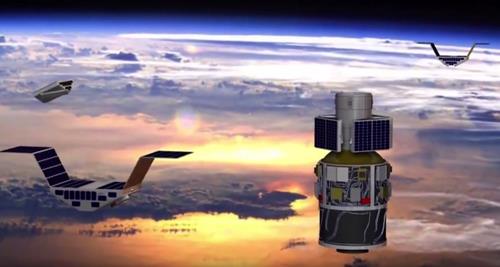
NASA Set to Launch New Fleet of Hurricane-Tracking Small Satellites. Cyclone Global Navigation Satellite System
Current hurricane-tracking satellite systems struggle to measure the insides of hurricanes — the action at the center. The heaviest rains obscure the vision of satellite instruments. The eight microsatellites will use new GPS technology and analysis techniques to better predict what exactly is going on beneath the rain.
“Today, we can’t see what’s happening under the rain,” Chris Ruf, a principal investigator on the CYGNSS mission and a professor of climate and space sciences at the University of Michigan, said in a news release.
“We can measure the wind outside of the storm cell with present systems, but there’s a gap in our knowledge of cyclone processes in the critical eyewall region of the storm
Experimental models currently do their best to guess, but their predictions are without enough quality data. CYGNSS aims to fill the data gap.
The eight satellites can make measurements more frequently and from different angles. Together, the constellation can record 32 ocean surface wind measurements per second. The faster flow of more revealing data will make prediction models more accurate.
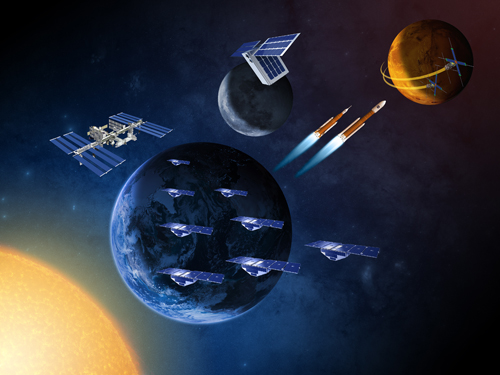
NASA to Hold Media Call on New Small Satellite Missions to Study Earth
“This is a first-of-its-kind mission,” said Thomas Zurbuchen, associate administrator for NASA’s Science Mission Directorate in Washington, D.C. “As a constellation of eight spacecraft, CYGNSS will do what a single craft can’t in terms of measuring surface wind speeds inside hurricanes and tropical cyclones at high time-resolution, to improve our ability to understand and predict how these deadly storms develop.”