05 May 2015
Islamic fundamentalism and extremism which have dominated the region will ultimately end only with the demise of this regime
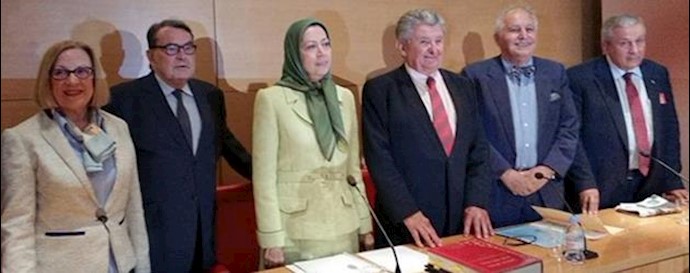
Maryam Rajavi discussing Iran nuclear weapons program at the French Senate
Mr. Chairman,
Honorable senators,
Ladies and gentlemen,
I am glad to be with you today. I appreciate the French Committee for a Democratic Iran who sponsored this meeting. We are meeting at a time when the question of Iran is the source of trepidation more than ever. Please allow me to address three issues in this regard:
First the Iranian regime’s bellicosity in the region, second some erroneous assumptions about the regime and finally the Iranian Resistance’s view on the nuclear agreement.
Let me begin by saying that the religious dictatorship ruling Iran is the cause of instability in the region. It leads at least ten terrorist paramilitary groups (militia) and it sends weapons for the fundamentalist groups in Africa. Its interferences have led to the virtual disintegration of four countries in the Middle East. But this is not a sign of the regime’s power. Revolutionary Guards Corps commanders have repeatedly pointed out that if they stop meddling in these countries, they will have to fight the war in Tehran with an angry populace.
Without such interferences and without the nuclear bomb, the power of the Vali-e Faqih will rapidly diminish and the balance of power between the regime and society will be upset.
We strongly believe that this is the descending phase of the regime and it can be seen everywhere particularly in the Iranian society.
Following the social uprisings in 2009, the protest movement was silenced under massive repression but today, is on the rise again. Last year, there were 5700 protests and the movement of teachers and workers has been growing by the day.
As for the economy, the unemployment rate stands at 40%, the economic growth rate is less than 1%, foreign investment is zero and 75,000 projects have remained incomplete.
It is not without reason that executions have been stepped up. Under Rouhani, the number of executions has reached 1500 so far.
The regime finds itself vulnerable more than any other time in the face of resistance. This is why it is working full force to keep opposition members in Camp Liberty in Iraq under blockade and clampdown. Last month, another Camp Liberty resident died. He was the 25th to lose his life due to the medical siege imposed on the camp.
In most of its diplomatic engagements, the regime’s first demand is pressuring the Resistance. At this point, let me urge the government of France to take action in the framework of the European Union and the UN Security Council to have Iraq provide protection of Camp Liberty and lift the oppressive blockade imposed on it.
As for the region, the regime is similarly on a descending trend in Syria and Iraq. In Yemen, the mullahs wanted to occupy the country and thereby reach a better balance but the formation of the Arab Coalition turned the situation against Tehran. This situation helps respond to some wrong assumptions about the clerical regime:
There is an assumption that the Iranian regime and the West are natural allies in confronting the ISIS. This is a dangerous mistake because the mullahs want to expand their dominance of Iraq and Syria and more than confronting the ISIS, they are engaged in a dreadful cleansing of the Sunnis.
There is also a bogus assumption that the Iranian regime can be part of the international community whereas the mullahs believe that any adaptation to international norms works against them. Occasional visits to Tehran by parliamentary groups would not guide them to the right course, but will aid the mullahs in escalating their violations of human rights.
And finally, the mullahs’ propaganda aiming to portray the regime as a regional power are invalid. Quite the reverse, this regime is extremely unstable. Despite the efforts of their lobbies, the French President and Foreign Minister believe that the regime has a destabilizing role in the Middle East.
I should emphasize that there is a solution: Arming the Iraqi Sunnis and tribes to confront the ISIS, aiding the moderate Syrian Opposition to remove Assad’s dictatorship, and removing the Iranian regime’s forces from Iraq and Syria, are all components of this solution. Lastly, as I declared at the hearing of the U.S. House subcommittee, Islamic fundamentalism and terrorism which have dominated the region with the mullahs’ rise to power in Iran, will ultimately end only with the demise of this regime.
Ladies and gentlemen,
Tehran’s nuclear program is a major challenge to peace and security. Unfortunately, western governments and most of all the United States, have veered off the UN Security Council resolutions in this regard. They gave excessive concessions to the mullahs so much that they came so close to acquiring the atomic bomb.
In his assessment of the developments in Iraq and Libya, the regime’s supreme leader Khamenei is convinced that acquiring the bomb is indispensable to his hold on power. So to avoid being overthrown, the mullahs will not hesitate to resort to any duplicity, fraud and breach of agreement to obtain the bomb.
The mullahs never respected their obligations to the European Troika in 2005. They broke the seals on the enrichment sites and refused to abide by 12 IAEA Governing Council resolutions and six UN Security Council resolutions.
Accordingly, I would like to declare on behalf of the Iranian people’s Resistance:
1. From the standpoint of Iran’s ruling mullahs, the nuclear bomb is essential to their survival and to their dominance over the region. Khamenei’s fatwa on the unlawfulness of nuclear weapons is a deceit. Khomeini told Khamenei that the “Vali-e Faqih (or the supreme leader) can unilaterally revoke his religious contracts with the people” should the interests of the regime demand;
2. Tehran’s nuclear projects are antipatriotic and the people of Iran strongly oppose them. In diametric opposition to the regime, we seek a democratic and non-nuclear Iran;
3. Acquiring the nuclear bomb, violation of human rights, export of fundamentalism, and terrorism are four pillars of Iran’s ruling theocracy. The situation of human rights in Iran, as well as the expulsion of the mullahs from Iraq, Syria, Lebanon, Yemen, Afghanistan, etc. are the proper gauges indicating whether this regime has given up on nuclear bomb. Anything less, under whatever pretext, is a deceit tantamount to capitulating to the catastrophe of nuclear-armed mullahs;
4. The addition of six or nine months to the break out time is not any solution for a regime that has been engaged for three decades in concealment and deception. The only guarantee is to implement the six UN Security Council resolutions, put a full halt to enrichment, and compel the mullahs to close off its nuclear sites as well as its relevant WMD and missile projects;
5. Intrusive inspections of all military and non-military sites, anytime and anywhere;
6. The regime should account on the military dimensions of its nuclear projects, nuclear experts and networks smuggling nuclear equipment;
7. Snapping back sanctions in case of the Iranian regime’s breach of agreement or cheating is neither practical nor realistic or logical. No sanctions should be lifted until the regime has completely set aside its nuclear program, otherwise they will use the money to buy weapons including advanced missiles from Russia;
8. According to the Iranian Resistance’s 36-year experience, Tehran mullahs understand only the language of force and firmness. The time has come for major powers to stop appeasing and giving concessions to this bloodletting religious tyranny, the central banker of terrorism and the world’s top ranking country carrying out the death penalty. Instead, they should recognize the Iranian people’s right for resistance and freedom.
I hope that France would continue the deterrent role it played in recent negotiations against appeasing policies, and lead the initiative to close the mullahs’ pathways to the nuclear bomb.
I thank you all.