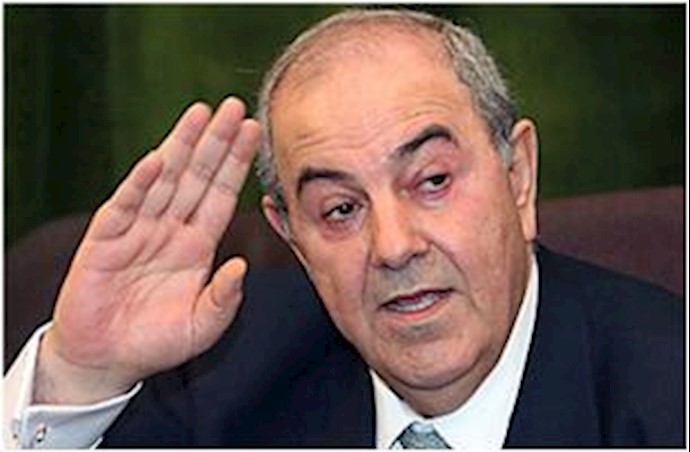
Time Magazine, Baghdad, Tuesday, May. 11, 2010
Monday was the deadliest day in Iraq this year. About 100 people were killed and more than 300 injured in a series of assassinations and assaults across the country. The violence takes place amid the continuing impasse in the formation of a government in the wake of the March 7 parliamentary elections. No political party had the decisive number to take control. The two biggest blocs belonged to former prime minister Iyad Allawi, whose Iraqiya party took 91 seats, and current Prime Minister Nouri al-Maliki, whose State of the Law party had 89. Parliament has a total of 325 — with 163 needed to form a majority. In an interview with TIME, Allawi angrily accused the international community of undercutting what he calls his victory at the polls, after first supporting the results. “We came first,” he said, “Now they are silent, the [U.N.] Security Council, they kept their mouth shut.”
After the elections an electoral court ruled it wasn’t the top vote-getter that has the right to form the next government, but the biggest bloc of newly elected members of parliament, turning the post-election period into a time of high stakes horse-trading. In Iraq’s parliamentary math, Allawi and Maliki together have enough seats to form a government. But the two leaders dislike each other so much that a one-on-one meeting has yet to take place. Maliki has instead turned to another slate, the Iraqi National Alliance led by cleric Moqtada al-Sadr and other religious leaders to form what U.S. Ambassador Christopher Hill called this week “a Shi’a mega-party.” The religious slate only needs four additional seats to form a party, and by doing so could edge out Allawi altogether.(See the dark clouds of Iraq’s political chaos.)
That leaves the former prime minister, a canny political animal himself, in high dudgeon. “The trend is really simply to rape democracy in this country,” Allawi says. “To get democracy undermined. Because everywhere in the world democracy is democracy and the winner is the winner, whether it’s one seat or two seats or a hundred seats.”
Meanwhile, the violence that has ramped up in the days since the election has a decidedly political edge. Allawi says he is under constant threat himself and the government is doing little to help protect him. “We live every single day under a threat that we are going to be assassinated,” he says. “I ask for support from the government, as an ex-prime minister…. Nobody cares a damn.” Asked to specify what kind of support he has asked for, Allawi says, “Cars, communication gear, these bomb detection, anti-detonator things… These cost a lot of money. It’s not free of charge. We need the government to protect us as they protect others. But this is not happening. I have to go to personal friends to donate a car, an armored car. It’s ridiculous.”(See what has become of the palaces of Saddam Hussein.)
Allawi is particularly furious that the impasse has allowed other rivals to whittle away at contested seats with a campaign of “debaathification” — that is, purging politicians with ties to Saddam Hussein’s ousted Baath party. “This smearing campaign was something unbelievable: the Baath Party is coming back to power, Saddam Hussein is coming out of his grave and things of this nonsense.” (Allawi’s party crosses sectarian lines; Maliki’s is predominantly Shi’ite.)
In his interview with TIME, Allawi blamed Iran, Iraq’s enormous Shi’ite neighbor to the east, for the electoral mess in his own country, pointing to an invitation to the leaders of three rival parties to visit Tehran. After the meeting in Tehran, he says, “then they started the heavy process of renewed debaathification.” He says the U.S. supports him in blaming Iran, referring to statements by General David Petraeus, commander of U.S. Central Command, and General Raymond Odierno, commander of U.S. forces in Iraq.
Allawi is unabashedly frustrated by the pace of negotiations between Iraq’s political parties. “We are moving, frankly, in a vicious circle,” he says. “And not getting out of it. The discussions, they come and discuss with you and then they declare a union between [two other parties]. The Kurds say we are going to side with the Shi’ites and then we have a statement that Iraq should be split into three: a Shi’a, a Kurdish and a Sunni [division]. It’s all a mess.”
He doesn’t rule out forming a coalition with Maliki’s party. “I have offered through the United Nations, through his deputy, through the delegates that went from Iraqiya to talk to their people.” But Maliki, he says, is holding out. “He agreed in principle [to talk]. I think he’s thinking that the numbers and figures [of seats in parliament] will be changing from the recount and the alliances from both sides… I think he is waiting for such results before he agrees.” But Allawi has conditions that must be met before joining in a government with his rival. “First of all,” he says, ” is to stop the debaathification. Return the rights of the people to the people. No changing the results. The United Nations should respect the results of the elections. … Release the prisoners and stop the intimidation. We have 10 of our people now, candidates who have won the elections, under threat of being in prison because of the politicized anti-terror law in this country, and they are on the run in Arab countries.” He reiterates: “What democracy is this? It is a big joke.”