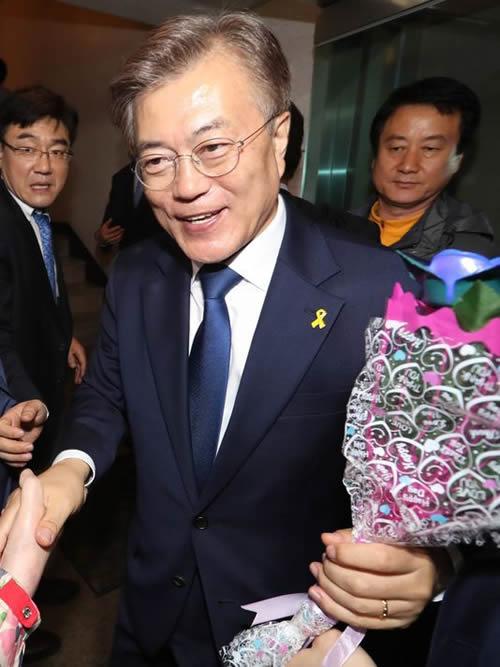
SEOUL, USA TODAY, May 9, 2017 — Liberal Moon Jae-in won South Korea’s presidential election after his two main rivals conceded defeat Tuesday.
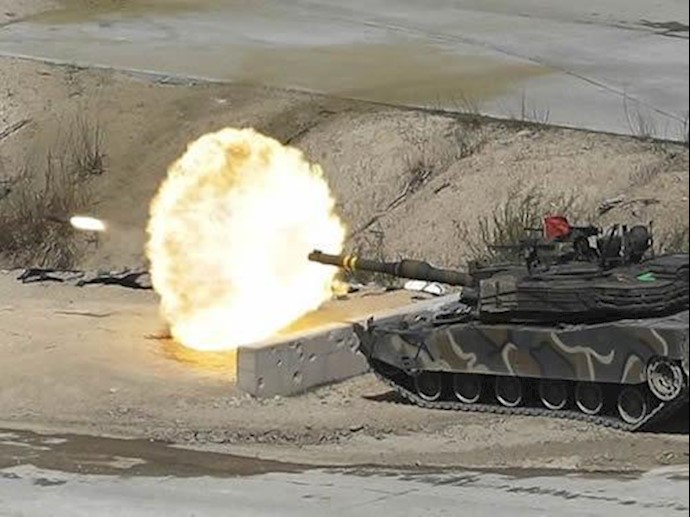
Flames rise as South Korean army’s armored vehicles wait during South Korea-U.S. joint military live-fire drills at Seungjin Fire Training Field in Pocheon, South Korea, on April 26, 2017
“I will build a new nation. I will make a great Korea, A proud Korea. And I will be the proud president of such a proud nation,” the human rights lawyer told supporters in Seoul, Yonhap News Agency reported.
Moon’s remarks came after an exit poll showed him as the clear winner of the election with 41.4% of the votes. Conservative Hong Joon-pyo and centrist Ahn Cheol-soo conceded after exit polls forecast Moon would win.
While the election result was driven largely by domestic concerns over corruption and a slowing economy, Moon’s stances, particularly over relations with neighboring North Korea, threaten to open a rift with the U.S., its long-term ally.
“I feel that not only my party and myself but also the people have been more desperate for a change of government,” Moon said earlier while casting his vote.
Moon has signaled a softer approach toward North Korea than the hawkish Park Geun-hye, the nation’s first female president, whose impeachment over corruption charges in March triggered the election. He has questioned the effectiveness of the strict sanctions against North Korea and left the door open for greater diplomatic and economic ties with the North.
“We can’t deny that the ruler of the North Korean people is Kim Jong Un,” Moon said during the campaign in March. “We have no choice but to recognize Kim Jong Un as a counterpart, whether we put pressure and impose sanctions on North Korea or hold dialogue.”
Moon has also been critical of the U.S. deployment of an anti-ballistic missile defense system known as THAAD (Terminal High Altitude Area Defense) in South Korea, a military move Park had endorsed. The U.S. began deploying elements of THAAD in late April on an abandoned golf course outside of Seoul and announced it was operational last week.
Moon argued that the U.S. should have waited for a new president to make the final decision to install the $1 billion system, which the Pentagon apparently rushed to make operational for fear Moon might block it if elected.
Moon’s conservative critics fear he will try to revive the “Sunshine Policy” of 1998-2008, when liberal administrations actively engaged North Korea but ultimately failed to stop the isolated communist regime from developing a stockpile of nuclear weapons and ballistic missiles.
President Trump rattled U.S.-South Korea relations in a recent interview with Reuters when he said he wanted South Korea to pay for the cost of THAAD. “We’re going to protect them,” Trump said. “But they should pay for that, and they understand that.”
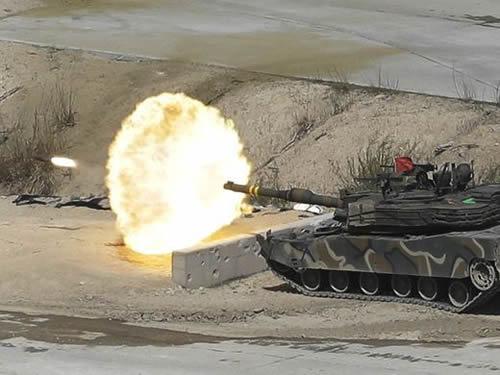
A South Korean army’s K1A2 tank fires during South Korea-U.S. joint military live-fire drills at Seungjin Fire Training Field in Pocheon, South Korea, near the border with North Korea on April 26, 2017.
Trump also said he planned to renegotiate or scrap the free-trade pact between the U.S. and South Korea, calling it a “horrible” deal.
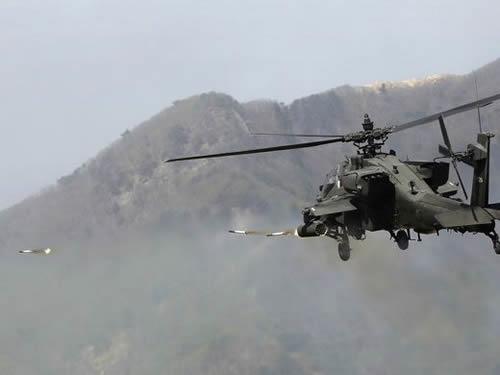
A U.S. Army’s Apache helicopter fires rockets during South Korea-U.S. joint military live-fire drills at Seungjin Fire Training Field in Pocheon, South Korea ,on April 26, 2017
In addition, Trump has consistently talked tough against North Korea, hinting at military action to end its nuclear and missile threats. That sparks fear of North Korean retaliation against the South Korean capital of Seoul, a metropolitan area of 25 million a mere 35 miles from North Korea’s border.
Moon seeks to re-position South Korea in its dealings with North Korea. “We must lead the efforts to solve problems related to the (Korean) peninsula,” he said during his campaign last month, “and our allies and neighboring countries, including the United States, should take on a role to support our leadership.”
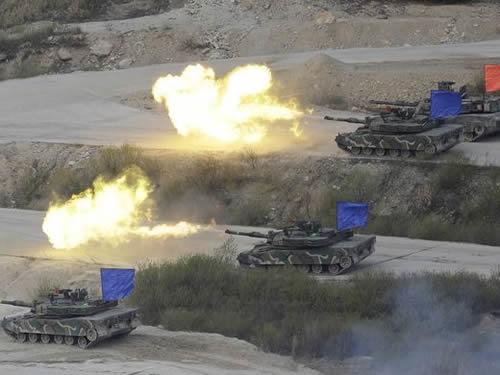
South Korean army’s K1A2 tanks fire during a South Korea-U.S. joint military live-fire drills in Pocheon, South Korea, on April 26, 2017.
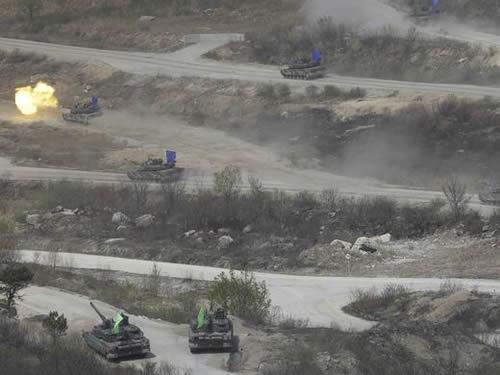
South Korean army tanks move during South Korea-U.S. joint military live-fire drills in Pocheon, South Korea
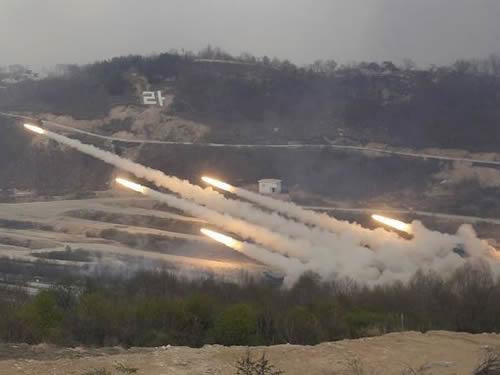
The South Korean army’s multiple launch rocket systems fire rockets during South Korea-U.S. joint military live-fire drills at Seungjin Fire Training Field in Pocheon, South Korea, on April 26, 2017
While Moon’s foreign policy positions look to alter the dynamics of the U.S. relationship, in South Korea, voters were focused primarily on anger over corruption and anxiety about jobs and slowing growth, according to pre-election surveys. In many ways, the election results were fueled by a strong backlash against Park and the culture of political and business corruption that has swirled around her administration.

The U.S. Army’s M1 A2 tanks fire during South Korea-U.S. joint military live-fire drills at Seungjin Fire Training Field in Pocheon, South Korea, near the border with North Korea on April 26, 2017
“At the end of the day, this election is the capstone of the (Park) impeachment,” said John Delury, an associate professor at Yonsei University Graduate School of International Studies in Seoul. “(Moon) is seen as clean. That’s one way his candidacy makes a lot of sense. He’s the anti-Park Geun-hye, he’s the furthest away from her while still being a mainstream choice.”
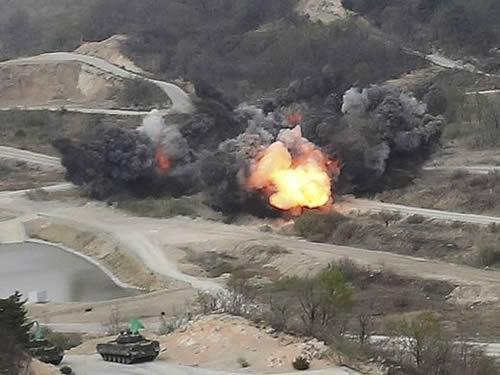
Flames rise as South Korean army’s armored vehicles wait during South Korea-U.S. joint military live-fire drills at Seungjin Fire Training Field in Pocheon, South Korea, on April 26, 2017