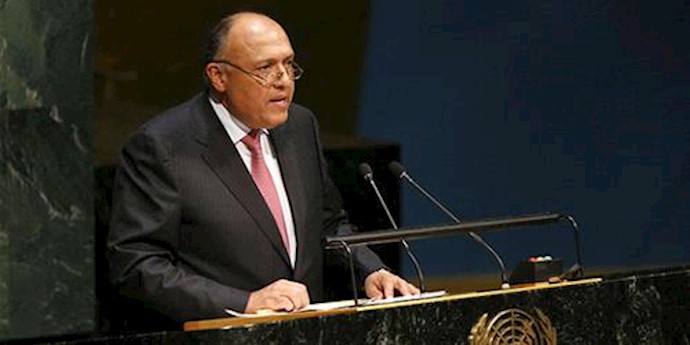
CAIRO —Egypt’s foreign minister has made a list of measures Iran must take before the two countries can discuss normalizing relations, but it’s doubtful that he really expects Iran to meet them.
During a March 31 interview with the Saudi newspaper Okaz, Egyptian Foreign Minister Sameh Shoukry said resumption of relations must be tied to several factors. Mainly, he said, Iran needs to change its approach and policies regarding the situation in the region; demonstrate a desire to build relations based on mutual cooperation, respect and parity of interests; respect Arab states’ independence and sovereignty; and practice non-interventionism.
Egypt’s foreign policy approach to Iran remains complicated. The Gulf countries are Egypt’s main engine, as they were first to support Cairo following the revolution of June 30, 2013, particularly Saudi Arabia during the reign of King Abdullah and then King Salman bin Abdul-Aziz Al Saud.
This was reflected in Sisi’s statement to Al Arabiya in May 2014, before he won the presidential election, when he said, “Iran is well aware that the relationship with Egypt goes through the Arabian Gulf. They are our family and we are keen on seeing them live in peace. All we seek with Iran is a fair relationship.”
In an interview with BBC Arabic in November 2015, Sisi said, “We have no relations with Iran. Egypt is greatly responsible for Arab national security, as it is an integral part of Egypt’s national security.”
Mohammad al-Saeed Idris, head of the Arab and regional studies unit at Egypt’s Al-Ahram Center for Political and Strategic Studies, told Al-Monitor that “conditions are not conducive for restoring relations between Cairo and Tehran.”
He said, “There is an Arab-Iranian conflict, especially with Saudi Arabia. Any rapprochement between Egypt and Iran would be viewed as a stance against Saudi Arabia. Iran has been taking wrong measures that exacerbate crises, such as its unjustified expansion in Yemen. This is not to mention its role in Iraq, whereby it is using the sectarian conflict by supporting Iraqi Shiites, preventing the achievement of real political stability.”
Idris, who is also a member of the people’s diplomatic delegation that visited Tehran after the June 2013 revolution, said, “Iran is doing the opposite of the conditions set by Shoukry. Should it commit to them, the Iranian-Saudi conflict would come to an end.” He said Tehran is unlikely to abide by Shoukry’s recommendations.
Iman Ragab, an expert on Gulf Affairs at Al-Ahram Center, told Al-Monitor, “Egypt is deferring dealing with the relations with Iran,” because — according to her — the history of relations between the two sides is mired with bilateral issues that Iran has not worked to resolve. Iran also did not respond to Egyptian demands regarding national security, specifically concerning Iran’s support for some armed groups in Gaza smuggling weapons through Egyptian tunnels, which is worsening the security crisis in the Sinai Peninsula.
“Moreover, the Egyptian ruling elite is deferring the issue of relations with Iran because of Saudi Arabia, which is taking a stance against the normalization of relations with Iran until it meets the conditions Saudi Foreign Minister Adel bin Ahmed al-Jubeir set forth during his visit to Cairo in May 2015, when he said that Iran should stop interfering in the affairs of the region’s countries, and desist from supporting terrorism and from taking actions undermining the interests of the region’s peoples,” said Ragab.
Commenting on Saudi Arabia’s role in the resumption of relations with Iran, Ragab said, “It is an important factor for Egypt, given the strategic relations between Cairo and Riyadh, especially following the June 30 Revolution. Egypt will not take any stance with Iran that could lead to tension in relations with Riyadh.”
She believes the conditions set by Shoukry for the normalization of relations amount to diplomatic games, since the minister is well aware that Tehran will not meet them, but “he is throwing the ball in Iran’s court, waiting for its next move,” she added.
Source: Al-Monitor, 27 APRIL 2016