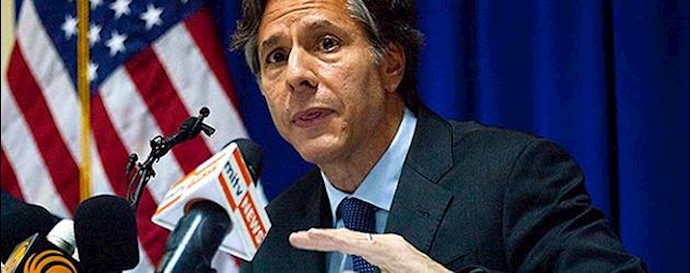
A senior US official has claimed that recent Kurdish gains in the area of the Turkish-Syrian border will help cut off supplies and personnel coming from Turkey to Raqqa, the de facto capital of the Islamic State of Iraq and the Levant (ISIL), Todays Zaman daily reported on June 28, 2015.
US Deputy Secretary of State Antony J. Blinken said at the Center for a New American Security that Syrian Kurdish forces in recent weeks have shown “dramatic gains” in Syria, supported by US-led air strikes. The US Army said that it conducted four air strikes near Kobani, a town on the border with Turkey, and hit ISIL targets. On Friday, June 26, US-led air strikes near Kobani hit eight units of ISIL fighters as well as several vehicles, fighting positions and staging areas used by the militant group.
Blinken said there is now a long stretch of the border between Syria and Turkey that is actually controlled by Kurdish forces which are allied with other Syrians.
Blinken added that the capture of border areas by Kurds is “critical,” because “if you can get that piece all across the border, you cut off the supply lines between Daesh and supplies and personnel coming in primarily from Turkey and going to Raqqa, their capital.” Daesh is the Arabic acronym of ISIL.
Obama’s envoy to the US-led coalition to fight ISIL, John Allen, told the US broadcaster PBS earlier this month that the capture of Tel-Abyad by Kurdish forces has been a “long-term effort” to ultimately cut off the border crossing. “And it, we believe, is one of the principal sources for supply to Daesh’s, or ISIL’s, capital in Raqqa to the south,” Allen said.
Blinken said since the US formed an anti-ISIL coalition last year, ISIL has lost 35 percent of the territory that it held or controlled at the time the coalition was formed. He said Syrian President Bashar al-Assad is a magnet for ISIL and “the best recruiting tool” that the extremists have — one of many reasons why Assad needs to be transitioned out.
Regarding the train and equip program the US is coordinating with partner nations in the region, including Turkey, Blinken said the program to build up moderate Syrian opposition is just starting to “really get off the ground.”
“It’s small, it’s slow, it takes time; it’s not a silver bullet,” Blinken said, adding that it can build on itself if it begins to show some success because recruits are getting effective training and the right type of arms.
The train and equip program hit several roadblocks in the first half of this year because Washington and Ankara could not quite agree on its objectives. The US says the program is designed to build up a robust ground force that could partner with the anti-ISIL coalition in fighting against the extremists. However, Turkey argues that the moderate rebels should also be able to fight against the Assad regime as it is the principal source of instability in the country.