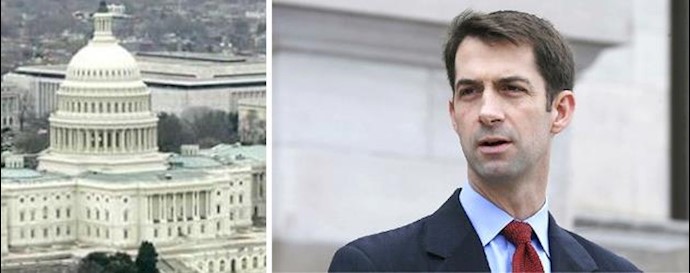
U.S. Sen. Tom Cotton said Wednesday that President Barack Obama and Democrats “bear a direct political, moral and personal responsibility for the coming crimes and outrages of Iran’s mullahs” after supporting the Iran nuclear deal.
Majority Leader Mitch McConnell, R-Ky., has scheduled a third vote today on the disapproval measure, adding language that would keep sanctions in place until Iran releases several Americans it is holding. Cotton, R-Ark., has been a vocal opponent of the deal. Last spring, he wrote an open letter to Iranian leaders stressing that future presidents could undo the deal because it wasn’t a treaty approved by Congress. He and the White House have traded barbs since.
In midsummer, he said that there was a secret side deal between the International Atomic Energy Agency and Iran detailing how Iran’s nuclear facilities would be inspected
In a 7½-minute speech on the Senate floor Wednesday, Cotton, said, “I feel, at times, as if I have exhausted my words.” He spent the bulk of his time reading quotes from a dozen of his Democratic colleagues who support the deal but have reservations about Iran’s trustworthiness and how Iran plans to use the billions of dollars it will get when sanctions are lifted.
“Despite their own words, these Democrats have chosen to give Iran billions of dollars that will be used to fund terror and war and ultimately put Iran on the path to nuclear weapons. So let there be no mistake for history about the consequences of these Democrats’ choice.”
He then said Democrats would be responsible if: Iran detonates a nuclear device; Iran launches a missile capable of hitting the United States; Iran kills more Americans as it has in Iraq, Afghanistan, and Lebanon, Saudi Arabia and elsewhere; Iran imprisons more American hostages; Iran attacks Israel through Hezbollah’s missiles or Hamas’ tunnels; Iran kills Jews around the world in places like Argentina and Bulgaria; or Iran massacres its own citizens.
“There will be grave consequences for them and for all of us,” he said.
Cotton said after the speech that he wanted on record that several Democrats support the deal despite having concerns.
“As we wind down this debate, history needs to record who was willing to stand by the president, stand by a deal that they recognize as disastrous, despite the national interests that they themselves acknowledge are implicated,” he said.
Cotton quoted U.S. Sen. Barbara Boxer, D-Calif., as saying, “Iran is a bad and dangerous actor. We all agree on that.”
Several of the senators Cotton quoted are up for election in 2016 or 2018. He was the last senator to speak on the Iran deal during the morning’s debate, and his Democratic colleagues didn’t respond to him directly.
“If Iran detonates a nuclear device or tests a ballistic missile or blows up Jews around the world or kills Americans or takes them hostage, [or] there’s another massacre in the streets of Tehran — I am sure that the people who sent them to the Senate are going to want an answer for why they supported what those senators in their own words acknowledged was a very dangerous deal,” he said.
In January, Cotton was selected as a vice chairman of the National Republican Senatorial Committee for the 2016 cycle, and is to help Republicans hold their majority in the Senate.
In a separate speech Tuesday night in Washington to Hillsdale College students and alumni, Cotton said Obama’s decision to pursue an “agreement” rather than a formal treaty, which needs Senate approval, “is the height of hubris.”
“The president’s decision to discard the treaty process mistakes tunnel vision for principle; close-mindedness for superior wisdom; and a search for a personal legacy for the vital national interest,” he said.
In a phone interview Wednesday, Cotton said companies that decide to invest in Iran are taking a substantial risk.
“They should think twice about committing their own money or their shareholder’s money into major projects in Iran, whether it’s in their oil industry or their gas industry or their shipping or what have you,” Cotton said.
“They all face significant reputational and financial and potentially criminal risk if they rush into Iran next year when sanctions begin to be lifted. All those sanctions could be back in place, or more, in less than a year, in January 2017.”