Peace negotiations are increasingly restricting Tehran
by Heshmat Alavi
OpinieZ (is an independent opinion magazine), 2 December 2017 – Developments around Syria have been given a major impetus after recent consultations between the leaders of the US and Russia. This also means a declining influence from Iran and a precursor to further setbacks for Tehran.
An hour-long telephone conversation between President Trump of the US and his Russian counterpart Vladimir Putin followed last Tuesday’s meeting of the latter with the leader of the Syrian regime Bashar-Al Assad. After spending billions in its campaign in the Levant, Iran is witnessing that its hegemony is declining as measures are being taken to end the Syrian war.
Moscow hands out the sheets
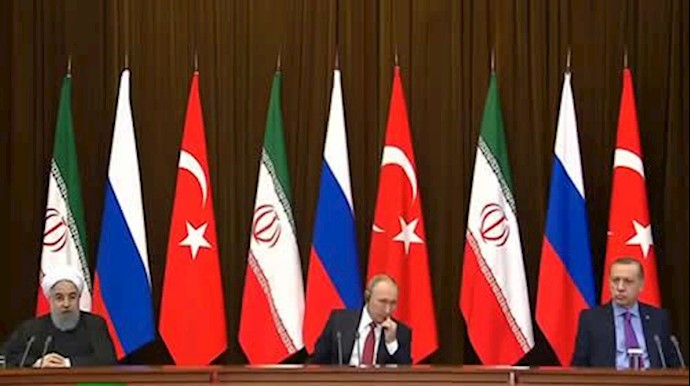
The leaders of Russia, Turkey, and Iran have agreed last week that there must be a full political solution in Syria. That happened in the context of a conference in the Russian Black Sea resort Sochi. Although some may view this as a victory for Iran, that is a premature conclusion. We must not be blind to the fact that Iran always wanted full power in Syria. Currently, the conditions indicate serious setbacks.
Putin’s hospitality for the talks about Syria points out that Moscow distributes the sheets. This causes great unrest in Iran, especially because of its six-year campaign to keep Assad in power. The very fact that Iran is at the table with Russia (which is also discussing various issues with the US) and with Turkey (which supports the Syrian opposition) leaves no doubt that Iran will have to show political flexibility.
Post-ISIS Syria
Many will argue that an agreement between Washington and Moscow provides the blueprint for the end of the Syria crisis. Can the talks in Sochi Tehran and Ankara align with Moscow and Washington? Doubts remain about this. Iran understands very well that a post-ISIS Syria has a high price.
And with a Russia that significantly reduces its military presence on the ground in Syria, Iran’s dreams of a Shiite crescent are in danger, if not worse. Furthermore, the fact that China is considering playing a role in the reconstruction of Syria after the war implies that there will be more stakeholders in the future of this country and that Iran will have a smaller share.
To safeguard its interests in Syria, Iran’s terrorist-designated Republican Guard has also set its sights on a share in the reconstruction of Syria. This should trigger alarm bells, especially because such a role would be a pretext for Iran’s efforts to maintain lasting influence in the Levant.
Higher interests
It is a fact that the reticence of Russia is not limited to Syria. On the international scene, Moscow and Washington enjoy a certain stature. Taking this into account, it is fairly obvious that Moscow will not sacrifice its higher interests in the world for Syria. The telephone conversation between Trump and Putin is a sign that there is coordination between the two countries in Syria. With Washington as the observer in the ongoing consultation in Astana about Syria, one can conclude that the American role in the Levant has not been played out.
American troops
Far from that, actually. US Secretary of Defense James Mattis recently said that the US will remain in Syria. “American troops, who are in Syria to fight Islamic State, do not pack their bags now that the jihadist group has been practically defeated. They stay “, Bloomberg reported. This is known at a time when the Pentagon is also likely to announce the presence of about 2000 militias in Syria according to Reuters,
Iran fully understands that the US presence in Syria is a dilemma for future plans in the region. Given the drastic consequences of Obama’s premature departure from Iraq, there are doubts that Trump will allow a repetition of this in Syria.
Saudi Arabia
As far as relations between Russia and Saudi Arabia are concerned, it can be concluded that Moscow will also take into account Riyadh’s caution with regard to Syria. Realizing that the support of the Arab world is crucial, Putin will strive for the approval of Riyadh.
In his recent meeting with the UN Special Envoy to Syria, Staffan de Mistura, Russian Foreign Minister Sergei Lavrov stressed how his government cooperated with Saudi Arabia to unite the Syrian opposition, with which he also supported the UN for this last attempt.
Unlike Iran, an Assad who remains in power is not a red line for Russia. And Moscow will want Ryad’s cooperation to get the rest of the Gulf Cooperation Council and regional states on the train to make a definitive end to the Syrian crisis.
This points to a more important role for Saudi Arabia, Iran’s arch-rival in the Middle East. Crown Prince Mohammed bin Salman described the Iranian Supreme Leader Ali Khamenei as “the new Hitler of the Middle East” in a recent New York Times interview.
Geneva Peace Council
What makes Iran more alarmed is the fact that the consultations in Sochi focused on bringing peace and stability to Syria, based on the UN Security Council resolution 2254. This consultation was even described by the Iranian state media as an “American and Zionist conspiracy” “.
The shadow of UN-backed solutions for Syria will continue to haunt Teheran. Putin also stresses that changes to a political agreement on Syria must be based on the agreement to be reached
United Syrian opposition
To make matters worse for Tehran, the Syrian opposition that met in Riyadh last Thursday agreed on the sending of a single block to the UN-backed peace talks. Nasr Hariri, a well-known Syrian opposition figure who has been elected as the new negotiating leader, has left for Geneva for the talks that started this week. According to Hariri, the opposition is prepared to “discuss everything on the negotiating table”.
Tehran would have been glad to have been able to keep the Syrian opposition apart, as we have seen during the six and a half years of war.
Iran’s dilemma
There is now an opportunity to end the battle in Syria, with a great chance of achieving a definitive political solution in the talks in Geneva.
Iran, however, is running on increasing violence in the region. Any reduction in tension goes against Iran’s interest, as it allows the international community to examine Iran’s warlike greed. Including the controversial nuclear program and the development of ballistic missiles, with which leading officers of the Revolutionary Guards recently threatened. That would extend Iran’s influence in the Middle East across the board by supporting terrorism and proxy groups and violating human rights.
No appeasement from Iran
In his aforementioned interview, the Saudi Crown Prince repeated how the world “from Europe has learned that appeasement does not work”. Now that the international community is trying to put an end to the war in Syria, Iran’s response to this vulnerable process must be strictly forbidden.