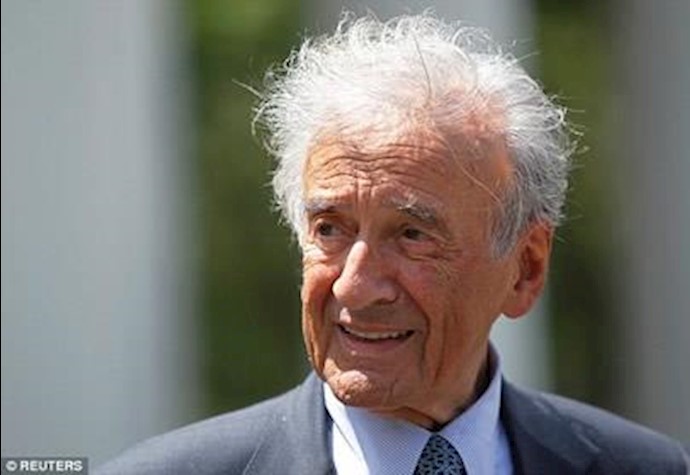
Nobel laureate Elie Wiesel, the Romanian-born Holocaust survivor whose classic “Night” became a landmark testament to the Nazis’ crimes and launched Wiesel’s long career as one of the world’s foremost witnesses and humanitarians, has died at age 87.
Wiesel was born in Romania in 1928.
At age 15, while pursuing Jewish studies, he and his family were taken by the Nazi’s to Auschwitz, where his mother and younger sister died.
Wiesel survived Auschwitz, but was later transferred to Buchenwald, where his father perished.
Wiesel’s experiences in the concentration camps became the basis for his book ‘Night’, which won him the Nobel Peace Prize in 1986.
Wiesel was liberated from the camp in 1945 and went on to study at the Sorbonne in Paris from 1948 until 1951.
He became a journalist and learned French, which became the primary language he wrote in publications.
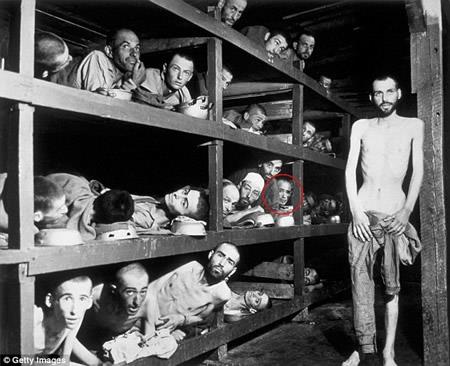
Wiesel (circled in red) was a victim of the death camps in Poland, including Buchenwald and Auschwitz
For the next decade he refused to discuss what he had been subjected to during the Holocaust. Later, a rabbi convinced him to document his experience in the camps.
Wiesel went on to write the Nobel Peace Prize winning ‘Night’, which told the story of his time in the concentration camps
His 900-page manuscript, ‘Un di velt hot geshvign’ meaning ‘And the World Remained Silent’ in Yiddish was eventually shortened to the 127-page La Nuit or ‘Night’.
Since its was first published in its long form in 1956, Night has been translated into 30 languages, became a New York Times best seller and has sold millions of copies internationally.
‘Silence encourages the tormentor, never the tormented. Sometimes we must interfere.
‘When human lives are endangered, when human dignity is in jeopardy, national borders and sensitivities become irrelevant,’ Wiesel said upon winning the Nobel Prize for the book.
Wiesel moved to the United States to live in Washington, D.C. in 1955.
In the 1970s Wiesel served as Boston University’s Andrew W. Mellon Professor in the Humanities.
He also taught Judaic studies at the City University of New York, and served as a visiting scholar at Yale.
He said his happiest time was when he was teaching.
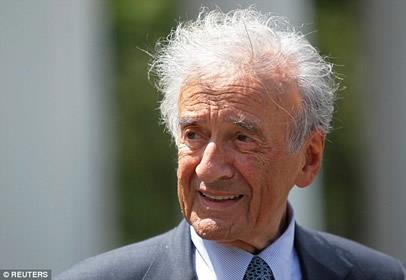
The short, sad-eyed Wiesel, his face an ongoing reminder of one man’s endurance of a shattering past, summed up his mission in 1986 when accepting the Nobel Peace Prize: “Whenever and wherever human beings endure suffering and humiliation, take sides. Neutrality helps the oppressor, never the victim. Silence encourages the tormentor, never the tormented.”
For more than a half-century, he voiced his passionate beliefs to world leaders, celebrities and general audiences in the name of victims of violence and oppression. He wrote more than 40 books, but his most influential by far was “Night,” a classic ranked with Anne Frank’s diary as standard reading about the Holocaust.
“Night” was his first book, and its journey to publication crossed both time and language. It began in the mid-1950s as an 800-page story in Yiddish, was trimmed to under 300 pages for an edition released in Argentina, cut again to under 200 pages for the French market and finally published in the United States, in 1960, at just over 100 pages.
“‘Night’ is the most devastating account of the Holocaust that I have ever read,” wrote Ruth Franklin, a literary critic and author of “A Thousand Darknesses,” a study of Holocaust literature that was published in 2010.
In one especially haunting passage, Wiesel sums up his feelings upon arrival in Auschwitz:
“Never shall I forget that night, the first night in camp, which has turned my life into one long night, seven times cursed and seven times sealed. Never shall I forget that smoke. Never shall I forget the little faces of the children, whose bodies I saw turned into wreaths of smoke beneath a silent blue sky. … Never shall I forget these things, even if I am condemned to live as long as God Himself. Never.”
“
Wiesel’s prolific stream of speeches, essays and books, including two sequels to “Night” and more than 40 books overall of fiction and nonfiction, emerged from the helplessness of a teenager deported from Hungary, which had annexed his native Romanian town of Sighet, to Auschwitz. Tattooed with the number A-7713, he was freed in 1945 — but only after his mother, father and one sister had all died in Nazi camps. Two other sisters survived.
Source: News Media, 2 July 2016