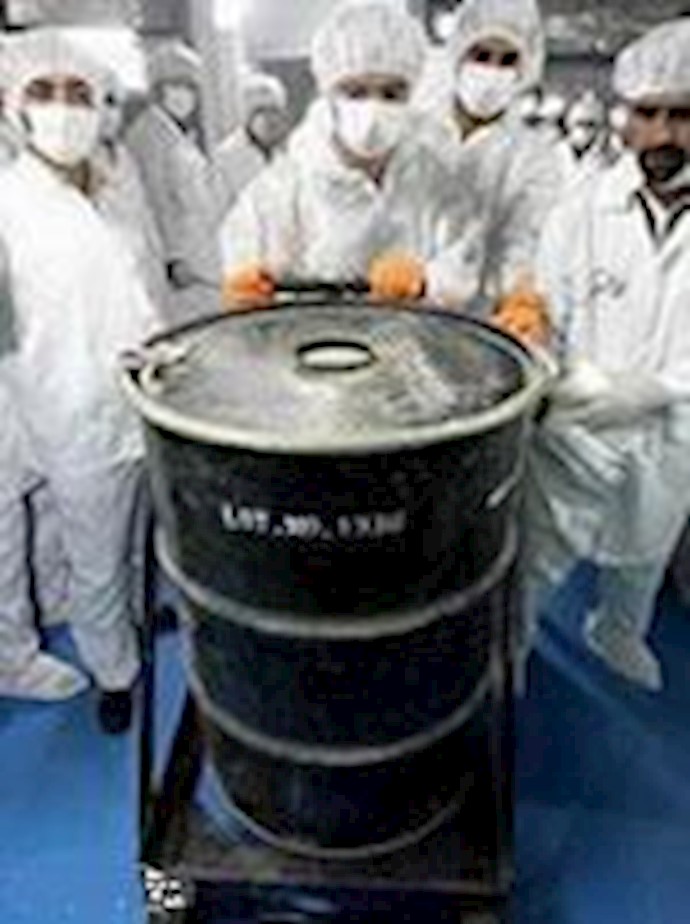
The New York Times, November 20, 2008 – Iran has now produced roughly enough nuclear material to make, with added purification, a single atom bomb, according to nuclear experts analyzing the latest report from global atomic inspectors.
The figures detailing Iran’s progress were contained in a routine update on Wednesday from the International Atomic Energy Agency, which has been conducting inspections of the country’s main nuclear plant at Natanz. The report concluded that as of early this month, Iran had made 630 kilograms, or about 1,390 pounds, of low-enriched uranium.
Several experts said that was enough for a bomb, but they cautioned that the milestone was mostly symbolic, because Iran would have to take additional steps. Not only would it have to breach its international agreements and kick out the inspectors, but it would also have to further purify the fuel and put it into a warhead design – a technical advance that Western experts are unsure Iran has yet achieved.
“They clearly have enough material for a bomb,” said Richard L. Garwin, a top nuclear physicist who helped invent the hydrogen bomb and has advised Washington for decades. “They know how to do the enrichment. Whether they know how to design a bomb, well, that’s another matter.”
Iran insists that it wants only to fuel reactors for nuclear power. But many Western nations, led by the United States, suspect that its real goal is to gain the ability to make nuclear weapons.
While some Iranian officials have threatened to bar inspectors in the past, the country has made no such moves, and many experts inside the Bush administration and the I.A.E.A. believe it will avoid the risk of attempting “nuclear breakout” until it possessed a larger uranium supply.
American intelligence agencies have said Iran could make a bomb between 2009 and 2015. A national intelligence estimate made public late last year concluded that around the end of 2003, after long effort, Iran had halted work on an actual weapon. But enriching uranium, and obtaining enough material to build a weapon, is considered the most difficult part of the process.
Siegfried S. Hecker of Stanford University and a former director of the Los Alamos weapons laboratory said the growing size of the Iranian stockpile “underscored that they are marching down the path to developing the nuclear weapons option.”
In the report to its board, the atomic agency said Iran’s main enrichment plant was now feeding uranium into about 3,800 centrifuges – machines that spin incredibly fast to enrich the element into nuclear fuel. That count is the same as in the agency’s last quarterly report, in September. Iran began installing the centrifuges in early 2007. But the new report’s total of 630 kilograms – an increase of about 150 – shows that Iran has been making progress in accumulating material to make nuclear fuel.
That uranium has been enriched to the low levels needed to fuel a nuclear reactor. To further purify it to the highly enriched state needed to fuel a nuclear warhead, Iran would have to reconfigure its centrifuges and do a couple months of additional processing, nuclear experts said.
“They have a weapon’s worth,” Thomas B. Cochran, a senior scientist in the nuclear program of the Natural Resources Defense Council, a private group in Washington that tracks atomic arsenals, said in an interview.
He said the amount was suitable for a relatively advanced implosion-type weapon like the one dropped on Nagasaki. Its core, he added, would be about the size of a grapefruit. He said a cruder design would require about twice as much weapon-grade fuel.
Peter D. Zimmerman, a physicist and former United States government arms scientist, cautioned that the Iranian stockpile fell slightly short of what international officials conservatively estimate as the minimum threatening amount of nuclear fuel. “They’re very close,” he said of the Iranians in an interview. “If it isn’t tomorrow, it’s soon,” probably a matter of months.
In its report, the I.A.E.A., which is based in Vienna, said Iran was working hard to roughly double its number of operating centrifuges.
A senior European diplomat close to the agency said Iran might have 6,000 centrifuges enriching uranium by the end of the year. The report also said Iran had said it intended to start installing another group of 3,000 centrifuges early next year.
The atomic energy agency said Iran was continuing to evade questions about its suspected work on nuclear warheads. In a separate report released Wednesday, the agency said, as expected, that it had found ambiguous traces of uranium at a suspected Syrian reactor site bombed by Israel last year.