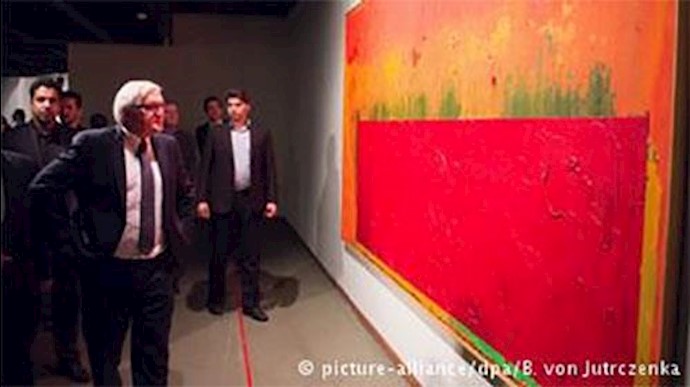
An exhibition on art from Iran has been canceled after Iran’s President reportedly refused to issue papers for the artworks to be exported to Berlin. The cancellation comes after serious accusations of Holocaust denial.
DW, Dec. 27, 2016 – It was supposed to be a major highlight for the cultural year ahead, and an important signal in improving ties between Iran and the West. But the planned exhibit “The Teheran Collection – Teheran Museum of Contemporary Art in Berlin” has now had to be called off entirely. The president of the Prussian Cultural Heritage Foundation (Stiftung Preußischer Kulturbesitz) Hermann Parzinger announced earlier that the much-anticipated art show would no longer be taking place.
After repeatedly suffering teething problems, the foundation “regrettably had to decide to take this step,” Parzinger said, adding that he had no choice but to cancel the intercultural cooperation agreement signed with the Teheran Museum of Contemporary Art (TMoCA) after Iran had failed to produce required export permits for artworks intended to be shown in Berlin.
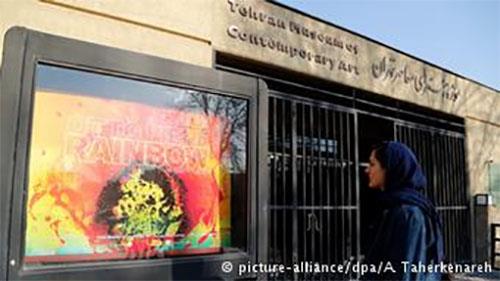
The Teheran Museum for Contemporary Arts (TMoCA) in recent years has started to show some of the previously banned art treasures from its vaults
The bureaucratic issue, as well as other stumbling stones, resulted in the art exhibition being delayed once before, with an intended opening date of December 4, 2016, being indefinitely postponed earlier in the year.
“We can’t stand for any further delays,” he stressed, underlining that his foundation was part of the government-run Berlin State Museums group (Staatliche Museen Zu Berlin), which could not afford to have further changes applied to its planning for the year ahead.
Parzinger said that his foundation would remain “in dialogue” with Iran, adding that the Prussian Cultural Heritage Foundation was always keen to nurture culture exchange.
A Holocaust on art
The exhibit was regarded as another key step in the overall notion of rapprochement between Iran and the West. Following the 2015 nuclear deal framework with Iran, of which Germany was also a signatory, the Prussian Cultural Heritage Foundation initiated the exchange, hoping to help open Iran further to the rest of the world by inviting the TMoCA to hold a show at the prestigious Berlin Portrait Gallery (Berliner Gemäldegalerie).
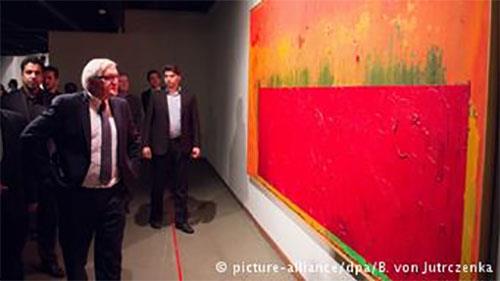
Politicians like German Foreign Minister Frank-Walter Steinmeier were instrumental in facilitating the planned exchange but had to distance themselves later