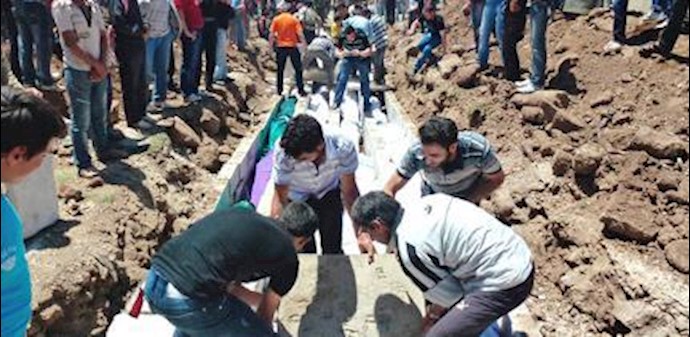
The New York Times, Beirut, Lebanon, May 29, 2012 — Several Western nations hardened their protest against Syria on Tuesday, expelling senior diplomats over the massacre of more than 100 people there, many of them children, last weekend. Their coordinated action came as the United Nations special envoy, Kofi Annan, was meeting with President Bashar al-Assad in the capital, Damascus, to shore up an apparently failing cease-fire.
The effort by countries including Britain, France, Germany, Australia, Spain, Italy and Canada to expel the senior Syrian diplomatic officials appeared timed to underscore the extreme isolation of the Syrian government and pressure Mr. Assad into honoring the terms of a nearly two-month-old peace plan negotiated by Mr. Annan. It followed comments by the chairman of the United States Joint Chiefs of Staff warning that continued atrocities could make military intervention more likely.
Mr. Annan in his meeting on Tuesday urged the Syrian government to hold to its commitment in March to abide by the terms of the peace plan, which included not only a cease-fire, but also political dialogue with the opposition and freedom for Syrians to demonstrate.
“He conveyed in frank terms his view to President Assad that the six-point plan cannot succeed without bold steps to stop the violence and release detainees, and stressed the importance of full implementation of the plan,” a spokesman for Mr. Annan, Ahmad Fawzi, said in a statement.
Questions about the viability of the plan were thrown into sharp relief by the massacre on Friday in the villages that constitute Houla, near Homs. Victims included 49 children and 34 women, according to a United Nations count. The Security Council on Sunday unanimously condemned the massacre and, while not assigning blame, censured the Syrian government for using heavy artillery against civilians.
But on Tuesday a spokesman for the United Nations high commissioner for human rights said that fewer than 20 of the victims in Houla were killed by artillery fire. “Most of the rest of the victims were summarily executed in two separate incidents,” the spokesman, Rupert Colville, told reporters in Geneva, news agencies reported. “At this point it looks like entire families were shot in their houses.”
The statement appeared likely to add to the uncertainty surrounding a massacre that opposition activists have blamed on the government and Syrian officials have portrayed as the work of terrorists. Deaths from heavy artillery can be pinned on government forces with relative certainty because such weapons are not held by opposition fighters. But responsibility for deaths at close quarters is harder to determine in a country where reporters have been prevented from moving about freely.
Villagers had told the United Nations monitors who came to Houla following the massacre that “shabiha,” or government thugs, had committed at least some of the killings at close range, and that those combatants tend to be Alawites, the minority sect that includes President Assad.
The aftermath of the killings continued to reverberate inside Syria. Shops, including the famous Hamadiyah bazaar of Damascus, stayed shut as part of an opposition-led call to observe three days of mourning, according to opposition activists and residents. Damascus has been a bastion of government support. The activists and residents said government agents forced some stores to reopen, particularly in the nut and candy bazaar, by prying open their metal shutters.
Mr. Annan, the envoy of both the United Nations and the Arab League and a former United Nations secretary general, arrived with a new mandate from the Security Council — including Russia, which had usually blocked action against its ally in Damascus — to carry out his plan.
He was to hold a news conference later Tuesday after his meeting with Mr. Assad and will also meet with a variety of other people, including opposition figures, on the trip, which was scheduled before the massacre.
From the beginning, the peace plan has been given slim chances of success. But it was seen as an acceptable means to try to bridge the differences over Syria between the West and the Arab nations on one side and Russia, China and Iran on the other.
Some analysts have called it an international stalling measure, because the Western appetite for military intervention in the conflict is low, even in the absence of Russian opposition.
In Washington, Gen. Martin E. Dempsey, the chairman of the Joint Chiefs of Staff, called the massacre “horrific” and “atrocious” and said that he was prepared with military options in Syria should they be requested by the White House. But he otherwise spoke cautiously about American intervention by force.
“There is always a military option, but that military option should always be wielded carefully,” General Dempsey said on Fox News. “Because one thing we’ve learned about war, I have learned personally about war, is that it has a dynamic all its own — it takes on a life of its own.” Nonetheless, he said, “it may come to a point with Syria because of the atrocities.”
White House officials said on Monday that General Dempsey’s television appearances were not a coordinated administration response to Syria, but had been previously planned as part of the commemoration of Memorial Day. In recent days, the Obama administration has come under intensified criticism by some in Congress and by the Republican presidential front-runner Mitt Romney, who accused President Obama of not doing enough to help the Syrian opposition.
In Moscow, the Russian foreign minister, Sergey V. Lavrov, was slightly more expansive in holding the Syrian government responsible for the violence during comments after a meeting about Syria with his British counterpart William Hague. And both he and Mr. Hague agreed that the main priority was to fully carry out the peace plan.
Mr. Lavrov repeated Russia’s position that it was tied not to Mr. Assad staying in power, but to the Syrians piloting their own political transition.
“For us, the main thing is to put an end to the violence among civilians and to provide for political dialogue under which the Syrians themselves decide on the sovereignty of their country,” he said.
Despite the increased Russian public pressure on the Syrian government, Mr. Lavrov did echo Syrian government claims that the violence was being fomented by imported terrorists working at the behest of foreign governments — “a clear hand of Al Qaeda, and the threat of terrorism is growing.”
Later, the Foreign Ministry issued a statement saying that Russia’s special representative to the Middle East, Mikhail Bogdanov, had told Riyad Haddad, the Syrian ambassador, that violence against civilians was unacceptable and that the six-point plan had to be implemented.
In Houla, where survivors buried their remaining dead in a mass grave on Monday, new accounts of the killings emerged, adding to earlier statements that some the attacks were by pro-government thugs who went house to house to find victims.
Human Rights Watch quoted one elderly woman from the Abdul Razzak clan as saying she survived by hiding in a back room while gunmen dressed in fatigues killed most of her family.