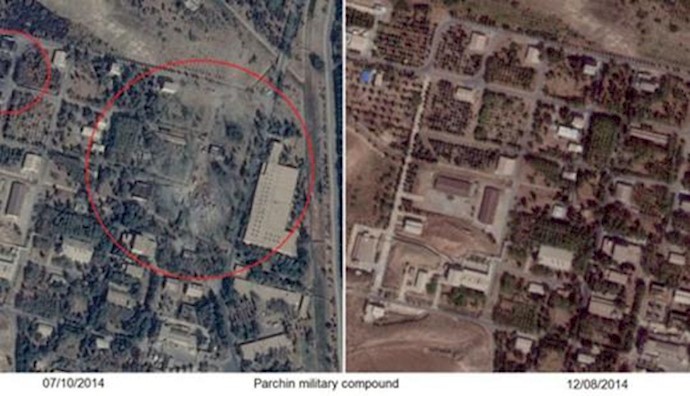
Washington – AP – OCT. 9, 2014 — A spectacular explosion on Sunday night outside Tehran took place deep inside the Parchin military base, where Iran produces crucial elements of its missiles and other munitions, raising new questions about whether the blast was an accident or sabotage.
The explosion and resulting fire, which Iranian news organizations have described in only the most general terms, could be seen from apartments in Tehran and appeared to have destroyed several buildings.
But it was distant from a part of the base to which the International Atomic Energy Agency has been seeking access for years, to investigate reports of experiments on high explosives that could have been used in nuclear weapons.
The agency’s evidence about that activity dates back more than a decade, and that part of the base has been so bulldozed and reconfigured in recent years that inspectors concede it is doubtful there is much left to see or test if they ever get access.
The explosion, according to satellite photographs from Airbus that were analyzed by the Institute for Science and International Security, took place in a densely built region toward the southern end of the base, in an area that appeared from past photographs to be littered with bunkers.
The damage was reminiscent of pictures of a missile-development site 30 miles west of Tehran that was virtually destroyed during a test in November 2011 that killed 17 people, including Gen. Hassan Tehrani Moghaddam, the leading force behind Iran’s advanced missile efforts.
The latest explosion, whether accidental or not, comes at a key moment in Iran’s confrontations with the West. It has resisted a series of efforts by the International Atomic Energy Agency to get answers on about a dozen separate issues, of which the activities at Parchin a decade ago were just one, and among the less sensitive. A trip to Tehran earlier this week, just after the explosion, by I.A.E.A. inspectors failed to make progress on that list, though the Iranians said the discussions were “very constructive.” Iran missed a deadline of Aug. 25 to provide a series of answers to the agency.
There is increasing concern among American negotiators that time is running short to negotiate what would be an enormously complex agreement.