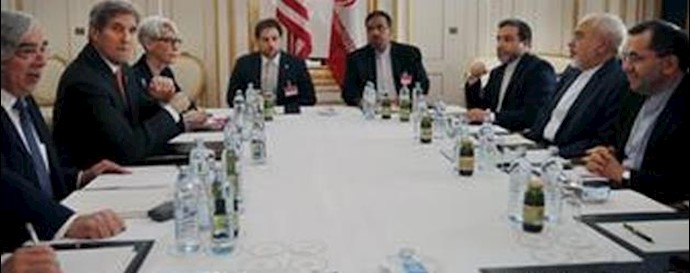
Iran is up against a June 30 deadline to agree to a deal with a coalition of world leaders, led by the United States, on its nuclear program. If that sounds familiar, it is because on two prior occasions these negotiations were extended when talks stalled. To keep them at the negotiating table, the administration bribed Iran by granting partial relief from Congressionally imposed sanctions. In fact, according to the Congressional Research Service, Iran has received “modest” sanctions relief to the tune of $700 million per month – mostly from oil sales – since the first deadline was extended in January of 2014. More of that money has gone to the Iranian regime, Iran’s global terror network including its support of Hezbollah, and Iranian influence-peddling in Iraq than to help ordinary Iranians.
The president and his administration have shaped the narrative surrounding the deadline by claiming we have only two options to prevent a nuclear Iran: either Iran accepts their deal or we go to war.
But there are other options; negotiators could stand firm and get a much better deal. Or we walk away from negotiations and re-impose the economic sanctions that brought Iran to the table in the first place. As yet another deadline looms, it is time to establish what an acceptable deal actually looks like and what should be done if Iran refuses to reach an accord with Western leaders containing those requirements.
First, and perhaps most importantly, an acceptable deal between the West and Iran must allow for inspection of known Iranian nuclear sites, suspected nuclear sites, and military facilities. Iran’s past clearly demonstrates that it cannot be trusted to adhere to international weapons obligations and there is no reason to believe it will begin now. The only way to fully certify that there are no nuclear weapons capabilities under development is to have verification inspections at ALL potential nuclear sites. To date, Iran has resisted granting access to military sites.
Next, Iran must finally come clean about previous weaponization efforts. This is a critical component of any deal. The international community must understand Iran’s capabilities in order to establish a baseline for measuring Iran’s nuclear breakout potential. The importance of understanding Iran’s capability is clear when considered in conjunction with the next objective.
An acceptable deal must also block Iran’s quest to develop nuclear weapons for decades to come. This can be achieved by restricting Iran’s uranium enrichment program to low-level enrichment only and making sure the agreement does not expire until Iran proves over time that its nuclear ambitions are peaceful. In addition, we must extend the “breakout time,” or the time it would take Iran to produce one nuclear weapon, beyond the one year pursued by the Obama administration.
Fourth, Iran must dismantle any nuclear weapons-related infrastructure. Iran has said that it might agree to disconnect some of its estimated 19, 000 centrifuges. But simply disconnecting centrifuges does little to slow Iran’s march towards a nuclear weapon because reconnecting centrifuges takes only several months at most.
Iran must also relinquish much of its Uranium stockpile. Allowing Iran to maintain a large stockpile of medium or even low grade enriched Uranium puts them much closer to developing a weapon, a scenario that risks regional and global stability.
Finally, relief from economic sanctions should come gradually and only if Iran complies with all of these various obligations. The international community must be clear and unified on this point. The immediate easing of sanctions and the unfreezing of assets does nothing more than give Iran the resources it needs to develop nuclear weapons capabilities. Rather, in order to maintain leverage in implementing agreement requirements, sanctions should only be eased as Iran clears certain non-weapon development benchmarks.
I am deeply concerned that this administration’s desire to “normalize” relations with rogue regimes, which have made no commitments to improve the rule of law or freedom of speech and press, may be driving its negotiating strategy. Another extension of these talks would be a grave error and give Iran’s despotic regime access to more cash to fund its nefarious activities. Accepting a bad deal would threaten our allies and partners in the region, and the international community as a whole. A deal that adheres to the five requirements outlined above will prevent Iran from obtaining the capabilities to develop a nuclear weapon and keep our allies and Americans safe.
By Rep. Joe Heck (R-Nev.): He has represented Nevada’s 3rd Congressional District since 2011. In the House of Representatives. He sits on the Armed Services; the Education and the Workforce; and the Intelligence committees.
The Hill, 26 June 2015.