SEOUL, South Korea, New York Times, 9 Dec. 2016- South Korea’s Parliament voted on Friday to impeach President Park Geun-hye… who rose to power with strong support from those who revered her father, the military dictator Park Chung-hee.
The vote against Ms. Park, the nation’s first female leader, followed weeks of damaging disclosures in a corruption scandal that has all but paralyzed the government and produced the largest street protests in the nation’s history. Her powers will now be suspended as the Constitutional Court considers whether to remove her from office.
Ms. Park has been accused of allowing a shadowy confidante, the daughter of a religious sect leader, to exercise remarkable influence on matters ranging from choosing top government officials to her wardrobe, and of helping her extort tens of millions of dollars from South Korean companies. The scandal, which gained national attention less than two months ago, has cast a harsh light on collusion between the presidency and big business in one of Asia’s most dynamic economies.
A total of 234 lawmakers voted for impeachment, well over the required two-thirds threshold in the 300-seat Parliament. The vote was by secret ballot, but the outcome indicated that nearly half of the 128 lawmakers in Ms. Park’s party, Saenuri, had joined the opposition in moving to oust her.
Parliament’s motion for impeachment, accusing Ms. Park of “extensive and serious violations of the Constitution and the law,” will now be taken up by the Constitutional Court, which has six months to decide whether the charges are true and merit her ouster.
Prime Minister Hwang Kyo-ahn, a former prosecutor and staunch defender of Ms. Park, will serve as acting president in the meantime. If the court votes to remove Ms. Park, South Korea will hold an election for a new president in 60 days.
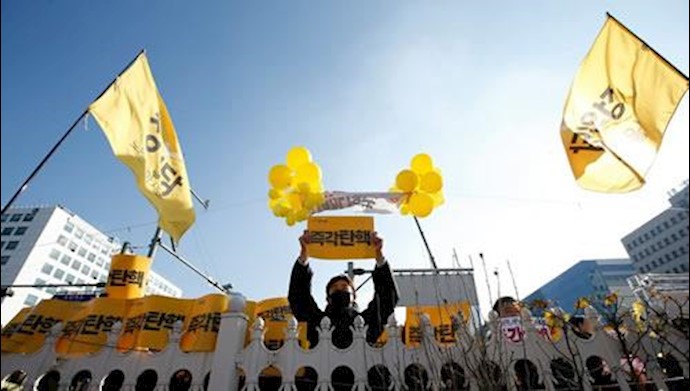
The vote for impeachment in the National Assembly, South Korea’s Parliament, was a victory both for the opposition and the huge crowds of South Koreans who filled central Seoul for the past six weekends demanding that she resign immediately or face impeachment. Recent surveys showed that a vast majority of South Koreans agreed with the demonstrators.
“It is a victory of the people’s will and Korea’s democracy,” said Kang Won-taek, a professor of political science at Seoul National University. “It is Korea’s glorious revolution, achieved without blood and without any serious violence.”
The last time South Koreans took to the streets to kick out an unpopular leader, in 1960, they had to fight bloody battles with police officers armed with rifles.
That uprising forced Syngman Rhee, the country’s founding and authoritarian president, to resign and flee into exile in Hawaii. Vice President Lee Ki-poong, a Rhee confidant who was at the center of a corruption scandal, and his family ended their lives in a group suicide as mobs approached their home in Seoul.
In subsequent decades, when South Koreans demanded more democracy, their military dictators, including Ms. Park’s father, brutally suppressed them through martial law, torturing and even executing their leaders.
In 1987, violence erupted again as people took to the streets to demand free presidential elections, forcing the military government to back down.
This time, in a sign of how far South Korea’s democracy has matured, peaceful crowds achieved their goal without a single arrest. Increasingly large numbers of protesters gathered in the capital, including about 1.7 million people on Saturday — the largest protest in South Korean history.
The protesters sang and danced to rock music and put flower stickers on police buses. They marched, some pushing baby carriages, while uniformed officers stood aside. And they neared Ms. Park’s presidential compound, chanting that she should step down immediately or face impeachment.