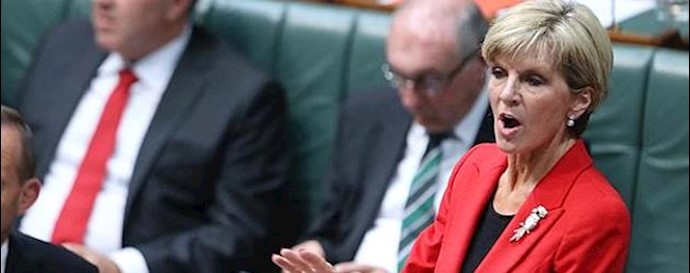
In recent weeks, Foreign Minister Julie Bishop, skidding in the oil slick of how to deal with Da’ish, has intentionally slid towards Iran.
On Friday, The West Australian newspaper reported that Bishop was close to signing a memorandum of understanding with Iran. Under this proposed deal, Australia might tone down its travel advisory, warning Australians not to visit Iran, and might grant Iran permission to build consulates in Sydney and Melbourne.
The idea of allowing Iran to open consulates in Melbourne and Sydney is a dangerous proposal and could exacerbate inter-Islamic community tensions, just as happened with the opening of Libya¬n and Syrian consulates in Australia under the Liberals in the 1980s and 90s. These were closed down later for security reasons.
Australia would also offer Iran scholarships for Iranian students and an increase in work and holiday visas for Iranians. In exchange for these concessions , Iran would provide for the return of failed Iran¬ian asylum-seekers.
This comes after the Foreign Minister advocated that Australia should extend to Iran military cooperation to Iraq. At the Paris meeting of allies opposed to Da’ish, she again advocated co-ordin¬ation with the Iranians in western Iraq. The intervention of Iranian-led Shia militias in the largely Sunni lands of western Iraq is one of the most counter-prod¬uctive responses we could make to Da’ish’s advances. The allies repud¬iated her proposals for increased co-ordination with Iran.
Bishop was the first Western foreign minister to visit since the Lausanne nuclear framework with Iran was announced. In 2012 it was very different. As opposition foreign affairs spokeswoman, Bishop came out swinging when an Australian diplomatic official planned to visit Iran. The prime minister “must immediately cancel” the visit, she demanded.
Autonomous sanctions had been imposed on Iran because of its pursuit of nuclear technology and failure to allow inspections by the International Atomic Energy Agency. She also pointed to Iran¬ian support for terrorist organisations and statements about Israel.
What has changed between then and now? Contrary to the blan¬dishments of former foreign minister Bob Carr from his pro-Beijing Australia-China Relations Institute, at the University of Technology, Sydney, Iran continues to illegally pursue nuclear weapons technology. Under the 2013 inter¬im agreement, Iran had to convert enriched uranium to the more benign uranium oxide, but has only converted 5 per cent. Worse, since that deal, Iran has produced four more tons of enriched uranium.
Further, in the last few days, Iranian Deputy Chief of Staff Brigadier-General Massoud Jazz¬ayeri said: “We reiterate that the permission will definitely never be issued for any kind of access (for inspectors) to the military centres.” This restates the definit¬ive comment by Supreme Leader Ayatollah Ali Khamenei that: “We will not allow the privacy of our nuclear scientists or any other import¬ant issue to be violated.”
The Deputy Commander of Iran’s Islamic Revolutionary Guards Corps said in January: “Hezbollah showed that … nowhere in Israel is safe now and the Israelis should wait for their death every day.”
As the definitive US State Department report said over the weekend, Iran still supports Hezbollah, which the Americans describe as an international terrorist organisation. Let’s remember that Hezbollah is officially classified by the Australian parliament as a terrorist organisation. Two thousand of Iran’s Hezbollah proxies have been killed in Iran’s attempt to preserve Syria’s Assad regime.
Bishop might look overseas for advice on Iran. As former Obama defence secretary and CIA chief Leon Panetta said: “The Iranians can’t be trusted.” Similar sentiments have been uttered by forme¬r US secretaries of state Condoleezza Rice (“You absolute¬ly cannot trust them”) and James Baker (“Experience shows Iran cannot be trusted”).
Whatever one’s views on the war in Iraq, our Foreign Minister is apparently committing Australia to indirectly assisting Major General Qassim Soleimani, the head of the Quds Force unit of Iran’s Revolutionary Guard Corps, against the Sunni tribes in western Iraq.
It was Soleimani who forced Iraqi leaders to reluctantly accept the reinstatement of Shia Iraqi prime minister Nouri al-Maliki after his failure in the 2010 elect¬ions and despite Maliki reneging on his agreement to support the Sunni Awakening in western Iraq.
Worse from an Australian perspective, there are increasing reports about Shia Iran backing the Taliban in Afghanistan with cash and arms to undermine the government of Afghanistan and remaining Western troops. Just as it did in Iraq, it is working to undermine what the West has achieved there. Australia has a major stake in seeing Afghanistan doesn’t go the way of Iraq. That’s why we and the US left troops to stiffen the Afgha¬n army.
Why is Australia partnering with a country so openly intent on undermining Australian and allied interests? How has the Abbott government been able to get away with this turn to Iran with so little scrutiny? Bishop owes parliament an explanation of what she means by “intelligence sharing’’. Does the government really support milit¬ary co-ordination with Iran?
Seriously, we can’t be giving the bombing co-ordinates of the Australian air force to Soleimani and Hezbollah. Consulates should not be opened here, nor travel advisor¬ies changed given the State Department report on Iran’s involvement with terrorism and parliament’s unchanged classification of Iran’s terrorist proxies.
Michael Danby is the Labor MP for the federal seat of Melbourne Ports
The Australian – June 22, 2015