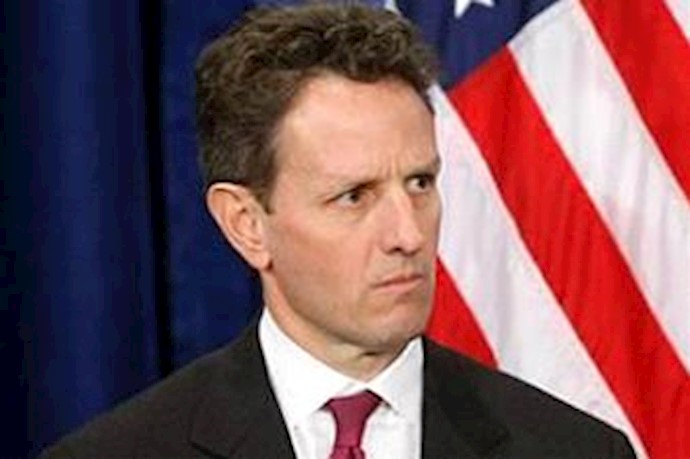
AFP, Beijing, 10 Jan 2012 – US Treasury Secretary Timothy Geithner arrived in Beijing Tuesday for talks focused on sanctions against Iran opposed by China, a major importer of oil from the Islamic republic.
The sanctions, signed into law by President Barack Obama on December 31, intend to put further pressure on Iran, which Washington accuses of pursuing nuclear weapons — a claim denied by Tehran.
Geithner is expected to encounter stiff opposition to the moves from Beijing during his trip, which will also take him to resource-poor Japan — another major consumer of Iranian oil.
On Monday China’s foreign ministry reiterated its rejection of the sanctions, which bar any foreign banks that do business with Iran’s central bank — responsible for processing most oil purchases in the Islamic republic — from US financial markets.
‘China’s trade and energy cooperation with Iran is normal, open and transparent, does not violate relevant UN Security Council resolutions, does not impact China’s stance on non-proliferation issues and should therefore not be impacted,’ said spokesman Liu Weimin.
Geithner will meet top Chinese leaders including Premier Wen Jiabao on Wednesday before heading on to Tokyo on Thursday, according to the US Treasury.
He will discuss ‘continued coordination with international partners in the region to increase pressure on the government of Iran, including financial measures targeting the central bank of Iran,’ it said in a statement.
The visit comes a day after the UN atomic watchdog said Iran had begun enriching uranium to up to 20 percent at a new plant in a fortified bunker sunk into a mountain, prompting alarm from Western powers.
But energy-hungry China — which relies on Iran for 11 percent of its imported oil supplies — has repeatedly said sanctions will not resolve the nuclear issue.
‘If you look at it (new law) purely from the letter of the law, it really puts the US and China on a collision course,’ said Patrick Chovanec, associate professor at Beijing’s Tsinghua University.
He said Geithner would use the visit to try to iron out differences with Beijing, which would prove a tough task.
‘From a broader strategic perspective, China is very unlikely to accept the US dictating who they can buy oil from and under what conditions,’ he said.
An editorial published Tuesday in the state-run Global Times daily, known for its nationalist stance, said China should continue trading with Iran ‘despite pressure from the US and European countries.’
‘If Chinese companies are sanctioned by the US due to their legal trade with Iran, China should take countermeasures,’ the paper said.
Jia Qingguo, a professor at Peking University’s American Studies Center, said China was still waiting to see whether the United States had ‘conclusive evidence’ that Iran is developing nuclear weapons.
‘If the United States asks other countries to impose joint sanctions against Iran only because it has tense ties with Iran, that’s not reasonable,’ he said.
International sanctions, meanwhile, have left resource-poor Japan searching for alternative supplies, officials say, as Tokyo tries to respond to US and EU concerns over Iran.
Japan is heavily dependent on the Middle East for its energy, with Iranian oil accounting for nearly nine percent of its power needs in the first 11 months of 2011 — an issue that Geithner is expected to discuss with Japanese leaders.
The treasury secretary will hold talks with Prime Minister Yoshihiko Noda and Finance Minister Jun Azumi in Tokyo on Thursday.