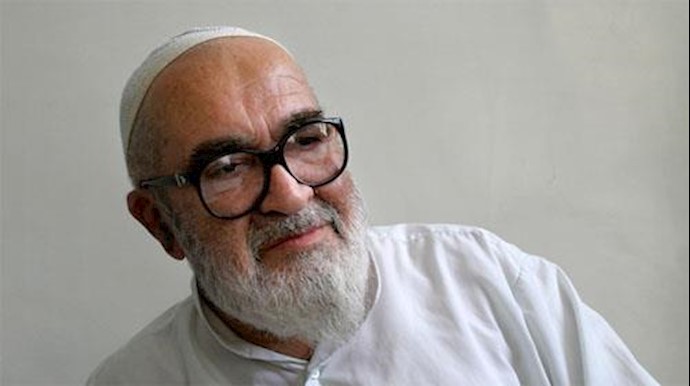
Iranian dissident cleric Mr. Montazeri at his home in Qom, 75 miles south of Tehran, May 19, 2005
An audio file recently released by the website of the onetime deputy supreme leader of Iran, Hussein Ali Montazeri has shed light on the cleric’s objections to a string of executions in the late 1980s and his eventual falling out with the ruling establishment.
In a recently released audio file, Mr. Montazeri can be heard disagreeing with the executions that took place in Iran in the late 1980s.
Khomeini shortly before his death ordered the execution of thousands of mostly MEK members who had been imprisoned in Iran after the 1979 Islamic Revolution.
Montazeri, who had been groomed to replace Khomeini and was one of the most well-known figures of the revolution, objected so adamantly to the order that he quickly lost his place within the government. His objection to the executions has been previously published in his autobiography. But the release of the audio file has brought this news to the surface once again and has revealed the harshness in which he dealt with the individuals involved.
In the audio file, Montazeri is heard speaking to Hussein Ali Nayeri, a judge at the time and a current deputy at the Supreme Court of Iran; Morteza Eshraghi, public prosecutor at the time; Ebrahim Raeisi, public prosecutor at the time and currently the head of the Astan Quds Razavi, one of the wealthiest institutions in Iran; and Mostafa Pourmohammadi, the Intelligence Ministry’s representative to Evin prison at the time and current justice minister.
In the 40-minute audio file, Montazeri says to them, “The biggest crime in the history of the Islamic Republic, which will be condemned by history, happened by your hands.” He said that a number of people and the Ministry of Intelligence had sought and waited for the opportunity to execute the MEK members and, after their attack on Iran in the summer of 1988, pushed the issue on Khomeini once again. In their coverage of the audio file, Fars News wrote that Montazeri believed that in the final years of his life, Khomeini was ill and those around him, especially his son Ahmed, was running his affairs. The Fars article, however, defended the executions and criticized the release of the audio file and Montazeri’s objections.
Many people have suggested if Montazeri would have kept his silence, he could have replaced Khomeini and been able to pursue his own policies and vision. Montazeri, however, rejected this reasoning, saying that if he was silent he would “not have an answer on Judgment Day and I saw it as my duty to warn [Khomeini].” Montazeri was also worried about what he would say to the families of those executed.
Montazeri also said that executing people for a crime when they are already serving time for other sentences undermines Iran’s judiciary.
Source, Al Monitor, Aug. 12, 2016