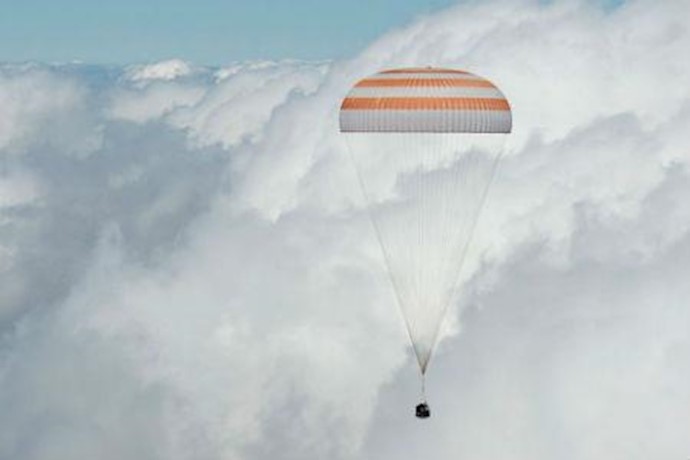
A three-man crew, including British astronaut Tim Peake, landed in the Kazakh steppe on Saturday after completing a six-month mission at the International Space Station (ISS).
Peake, the first British astronaut on the ISS, Russia’s Yury Malenchenko and NASA’s Tim Kopra parachuted down to Earth in their Soyuz capsule at 0915 GMT after spending 186 days in orbit.
Video footage from the landing site, southeast of the Kazakh city of Zhezkazgan, showed medics attending to the smiling men.
“It was incredible. The best ride I’ve ever been on,” Peake said. “It has just been fantastic, from start to finish.”
The 44-year-old former helicopter test pilot said he was looking forward to seeing his family.
“I’m going to miss the view,” he said, referring to his six-month stint in space.
The trio had blasted off into space from the Baikonur Cosmodrome in Kazakhstan in December.
At around 0215 GMT, they bid fairwell to NASA astronaut Jeff Williams and Russian cosmonauts Oleg Skripochka and Alexey Ovchinin, who remain aboard the ISS.
Their Soyuz TMA-19M spacecraft then undocked from the ISS, Russian space agency Roscomos said.
After undocking at 06:53 BST, the Soyuz performed two separation burns to distance the spacecraft from the orbiting outpost.
The vehicle then fired its engines again at 09:22 for a duration of four-and-a-half minutes to begin the re-entry through the atmosphere.
Screaming towards Earth at 25 times the speed of sound, the Soyuz was enveloped in a fiery ball of superheated plasma. During this phase, the crew members inside can be subjected to forces of about 5Gs – a level at which some people pass out.
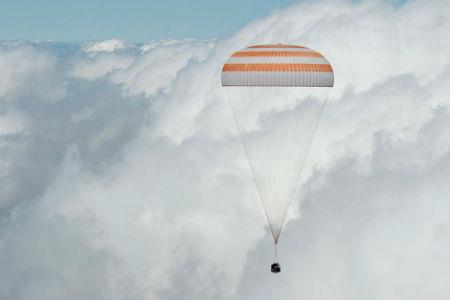
The Soyuz TMA-19M spacecraft descends to Earth carrying the Expedition 47 crew underneath a huge parachute.
As it neared the ground, the capsule deployed its parachutes to slow the descent, firing engines to cushion its landing on the steppe, near the Kazakh city of Dzhezkazgan at 10:15 BST.
After medical checks, Maj Peake will be flown from Karagandy airport on a Nasa gulfstream jet to Norway, and then on to Cologne, Germany, where the European Astronaut Centre is based.
Dr Simon Evetts, from the UK’s Harwell Science and Innovation Campus, said: “During re-entry, Tim will undergo significant strain on his body and will also feel the effects of his landmark mission for weeks to come.
“Upon arrival, Tim will feel weaker due to muscle loss and reduced cardiovascular fitness, and will feel heavy in Earth’s gravity.”
Peake’s mission has generated great excitement in Britain, where the government unveiled an ambitious new space policy on the eve of his departure for the International Space Station.
Peake’s time in space was marked by a number of milestones. In January, he became the first Briton to walk in space, undertaking a mission to replace an electrical unit.
In April he ran a marathon in space in record time, strapped into a treadmill while thousands ran the London Marathon.
Peake managed to achieve the fastest ever marathon in space by marking a time of three hours, 35 minutes and 21 seconds, setting a Guinness World Record.
The next launch of astronauts from the Baikonur cosmodrome is scheduled to take place on July 7.
It will take Anatoly Ivanishin of Russia, Kate Rubins of the United States and Takuya Onishi of Japan to the ISS.
Source: AFP, News Agencies, 18 June 2016